Next Wednesday marks International Bee Day, a global celebration of bees' vital role in plant reproduction and biodiversity. But for Damian Green, every day is Bee Day.
Driving through York and east to Kauring, I arrive at Bee Central, Damian's property. A dog greets me enthusiastically, followed by a trim man whose measured words belie his passion for bees, honey, and health.
A lifelong hobbyist beekeeper, Damian moved to the area about a decade ago, drawn by ideal soil and weather, proximity to Perth markets, and a television show that sparked his ecological curiosity.

“I saw a segment on Landline about the Flow Hive,” he says, referencing the Australian invention that allows honey extraction without disturbing the colony. “That got me in.”
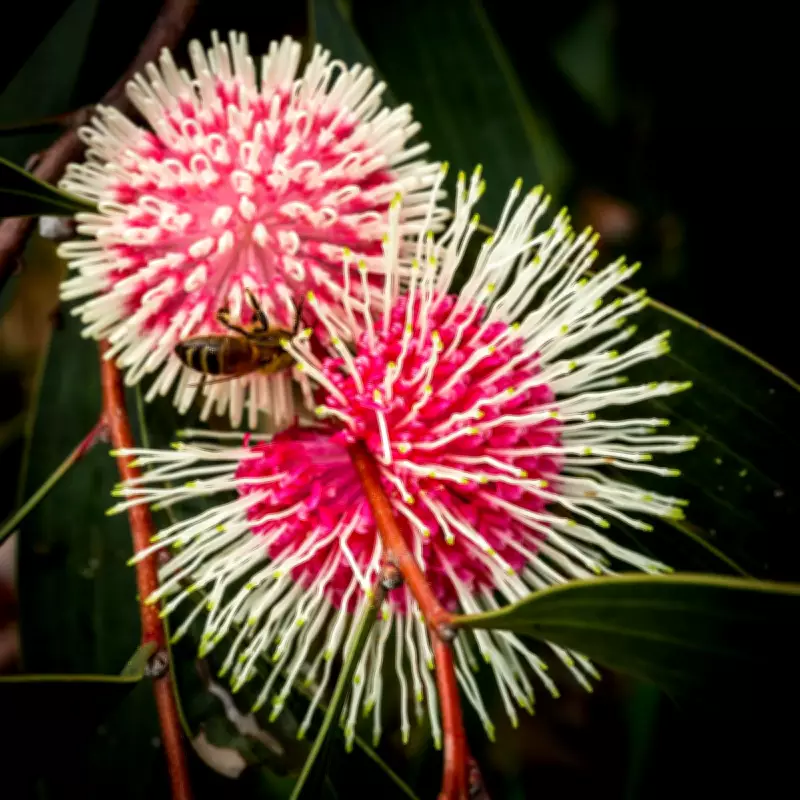
What kept him was the science. Australia is home to over 80 species of Leptospermum, the same genus behind New Zealand's famous manuka honey. Some produce honey three to four times more potent by measurable chemical indicators. Sixty of those species grow in Western Australia, thirty in the Wheatbelt, and several of the most active grow right here.
“Our medicinal honey is as good as, or more active than, New Zealand medicinal honey,” says Dr Peter Brooks, senior chemistry lecturer at USC Honey Lab. Damian agrees.
New Zealand has one Leptospermum species; WA has dozens. Honey from the most active, Leptospermum nitens—which Damian has trademarked as Kauring Active Honey—consistently tests stronger. A kilo retails for $300. A single jar takes six years to produce, from selecting genetically tested mother trees to planting seedlings, a four- to five-year maturation, and an eight-week flowering window when contracted hives are moved in.
Damian collaborates with local farmers and groups to form “plantation partnerships,” encouraging them to “convert or diversify land into 100 per cent native active honey bee plantations.” Plans include working with First Nations groups in Bremer Bay and near Katanning to promote natural Indigenous medicine.
He partners with the University of WA to support PhD research into bee health and active honey properties, and plans to establish a discovery centre in York with interactive displays, an auditorium, a cafe, and a retail outlet.
Green is also developing an essential oil from Leptospermum foliage, known for its antiseptic, anti-microbial, and antibacterial properties.
Currently, sheds house a distillery, extractors, and storage for jars of health-giving honey, along with Damian's living quarters and office.
“The big plan is a million tree-strong plantation in Meckering over five years,” he says, adding to the 225,000 already planted on his property and leased plots.
Here, it feels like a utopia. “We are regenerating the earth, not exhausting it,” Damian says, gesturing to the vast crop of Leptospermum nitens shrubs protected by white gums and about 5000 olive trees. “The roos love it here, and the bird life is incredible.”
As I head back to York for a falafel from Jules, I recall suiting up for an urban beekeeper visit and getting stung. A slow learner, I finally understand: we don’t know what we stand to lose by ignoring nature until it stings us into consciousness.

Fact File
- Bee Central is at 720 Cubbine Road, Kauring, about a 25-minute drive from York.
- To arrange a visit, contact Damian Green at admin@beecentral.com.au or on 0400 777 296.
- Damian Green is speaking at Scitech on Sunday May 24 at 12.30pm.
- To find out more about Bee Central and to purchase honey, visit beecentral.com.au