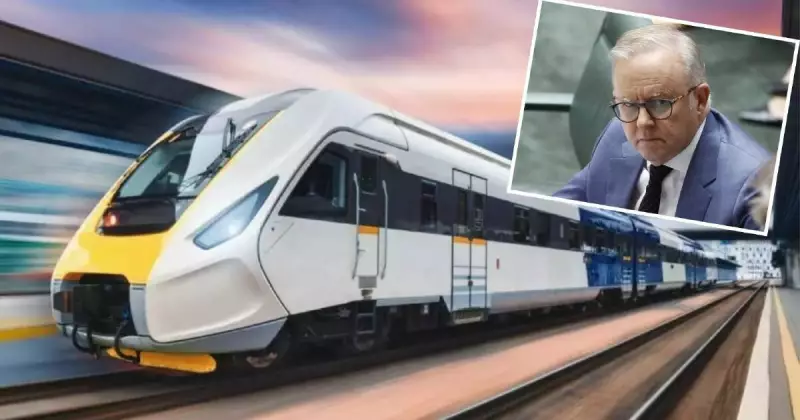
Prime Minister Anthony Albanese has publicly reaffirmed his long-standing passion for high-speed rail in Australia, yet offered few concrete details on how the federal government plans to fund the landmark project's first stage between Sydney and Newcastle.
A Long-Standing Enthusiasm, But Key Questions Remain
Speaking during a visit to Tomago Aluminium last week, Mr Albanese described himself as an "unashamed infrastructure nerd" and a "high-speed rail enthusiast." He reminded listeners of his pivotal role in launching a major east coast rail report back in 2013, when he served as Infrastructure Minister.
Despite this enthusiasm, the Prime Minister provided minimal insight into the critical issue of financing the construction of the initial leg. "You're pushing against an open door when it comes to high-speed rail," he stated, while deferring detailed questions to the established High Speed Rail Authority and the Minister for Infrastructure, Catherine King.

The Current State of Play: Funding, Timelines, and Routes
The project has reached a significant development phase, backed by $70 million in federal funding approved for planning, design, and environmental approvals. A further $667 million is being sought to advance this phase.
The High Speed Rail Authority, established after a $500 million commitment for corridor acquisition in early 2022, completed its business case in December 2024. The government confirmed its ongoing commitment in October this year.
Proposed construction could begin in 2027, subject to government funding approvals. The ambitious timeline aims to deliver:
- A Newcastle to Central Coast link by 2037.
- An extension to Sydney Central by 2039.
- A connection to Western Sydney International Airport by 2042.
Infrastructure Australia has endorsed the development phase, with its preferred proposal including stations at Newcastle, Lake Macquarie, Central Coast, Sydney Central, Parramatta, and Western Sydney International.
The Scale, Cost, and Economic Rationale
The dedicated line is envisioned to span 194 kilometres, featuring extensive engineering works including 115 kilometres of tunnels and 38 kilometres of bridges. Trains are designed to reach speeds of 320km/h on surface sections and 200km/h within tunnels.
While Infrastructure Australia has not publicly costed the project, industry experts estimate it between $30 billion and $40 billion. The economic case presents challenges; an analysis found that only under optimistic scenarios, which include significant land-use benefits, would the first stage's benefits outweigh its costs.
A substantial 58% of forecast benefits are tied to land use changes, anticipating up to 46,000 additional households due to improved accessibility. Infrastructure Australia has, however, raised questions about whether these projected housing benefits would fully materialise.
For now, while the Prime Minister's advocacy is clear, the pathway to fully funding and realising this transformative transport link remains the subject of keen anticipation and unanswered questions.