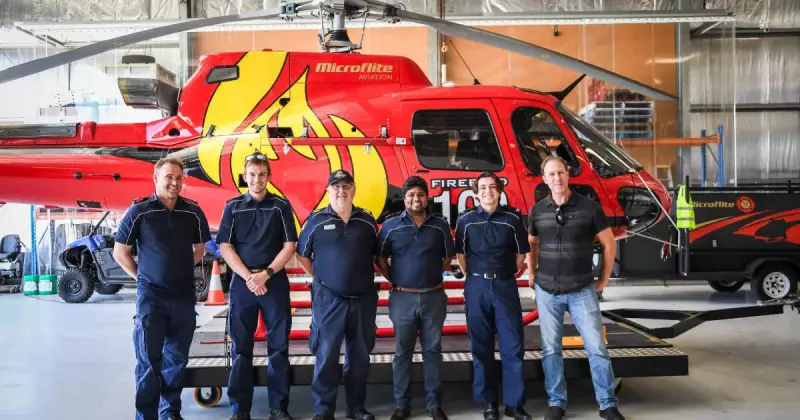
Canberra's frontline defence against summer bushfires now includes a secret weapon most residents have never seen. A specialist intelligence-gathering helicopter, equipped with a camera so powerful it can detect a smouldering fire in a tree trunk from an astonishing 75 kilometres away, has joined the ACT Rural Fire Service arsenal.
The Firebird's All-Seeing Eye
This critical detection capability comes from a highly sensitive infrared camera, larger than a human head, mounted beneath the Firebird 100 helicopter. The aircraft and its specialist geospatial intelligence team will support the ACT for the next 84 days, a period that can be extended. Camera systems operator Jason McFadyen described the technology as "pretty amazing."
The system feeds real-time footage directly to incident controllers at RFS headquarters. This live intelligence allows teams to instantly identify threatened properties, map active fire fronts, plan escape routes, and even assist in searches for missing persons. ACT RFS Chief Officer Rohan Scott praised the team's "behind the scenes" work, providing instant maps and data analysis to keep ground volunteers safe and strategically informed.

"If we get a lightning storm come through the ACT, which is forecast for the next couple of days, we can then fly Firebird 100, use its infrared camera, and it can pick up any lightning strikes that may not be detectable by the human eye," Mr Scott explained.
Aerial Fleet Bolsters Firefighting Capacity
The Firebird is not working alone. To strengthen the territory's aerial firefighting capacity until at least March 2026, the ACT RFS has also contracted two large waterbombing helicopters, known as "belly tankers." Flown in from Victoria, these aircraft can each carry between 12,000 and 15,000 litres of water, refilling their tanks from a lake, river, or farm dam in mere minutes.
Crewman Andrew Keegan said the crews are prepared for marathon shifts, providing aerial support for anywhere from one to ten hours daily. "We just keep going, as long as [ground crews] need water support, we'll just keep going," he stated.
Both waterbombing helicopters are also equipped with winching systems, a crucial feature for accessing remote terrain. The 250-foot electric winch cable can evacuate up to four firefighters from an inaccessible location in under 20 minutes.
"With those very remote fires that may be started by lightning, we can't actually drive there, or we can't walk into them, so we actually winch our remote area crews in," Chief Officer Scott said. These crews then use dry firefighting techniques to extinguish blazes or build containment lines.
Preparing for an 'Average' but Vigilant Season
While the high-tech resources are formidable, the ACT RFS is currently forecasting an "average" fire potential for the 2025-26 bushfire season. Chief Officer Scott noted that while vegetation is drying out—a normal seasonal cycle—the territory has not experienced the severe drought conditions that preceded the catastrophic 2019 fires.
"We are drying out, but that is a normal cycle, with the grass starting to cure," he said. He added that strong winds have accelerated drying and that expected spring rains did not fully materialise.
The service has a clear message for the community: preparedness is key. Residents are urged to develop a bushfire survival plan well in advance, maintain their properties, and stay informed through official channels like the ACT Emergency Services Agency website during incidents.
The contracted aircraft, stationed at the RFS helibase in Hume, come with their own pilots and engineers and are considered part of the service's "extended family." They are on pre-planned standby for days with a high fire danger rating, ensuring a rapid response when the community needs it most.