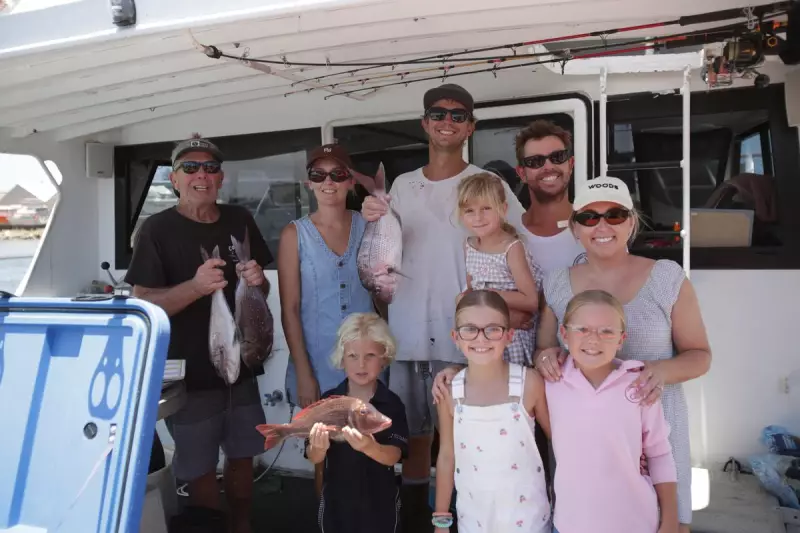
For the Mankelow family of Geraldton, a way of life spanning generations came to a poignant end this week. The Florence Fishing Co, operated by brothers Jed and Zac Mankelow alongside their father Russell, sold what may be their final catch at Fisherman's Wharf, surrounded by family and supportive locals.
A Family's Identity Cast Adrift
The emotional weight of the moment was palpable as the brothers handed fish directly from their esky to a community turning out in force. Zac's wife, Jasmine Mankelow, expressed the family's profound loss. "The boys are the second generation. It's their whole life," she said. "They've been fishing all their lives... it's everything, our livelihood, their identity, it's who they are."
She admitted the full reality of the situation had not yet sunk in. While the industry anticipated further restrictions, the announcement of a total commercial ban on demersal species caught them off guard. The ban, which commenced on January 1, 2026, prohibits commercial fishing for demersal fish in the West Coast bioregion from Kalbarri to Augusta.

Conservation Clash and Community Ripple Effect
The State Government, spearheaded by Fisheries Minister Jackie Jarvis, defends the move as a tough but essential measure. The aim is to protect iconic species like pink snapper and dhufish from potential extinction in parts of Western Australian waters for future generations.
However, the decision has ignited fierce criticism. The commercial fishing sector and local politicians label the ban as sudden, unnecessarily heavy-handed, and not sufficiently backed by science. Shadow fisheries minister and Geraldton MLA Kirrilee Warr has submitted a disallowance motion, calling it a "captain's call." If successful when parliament resumes in February, the legislation would cease.
The WA Fishing Industry Council (WAFIC) argues for sustainable fishing solutions over permanent closure. Chief executive Melissa Haslam warned of the extensive fallout. "This move comes at a significant financial and emotional cost, not just to commercial fishers, but to the fishmongers, retailers, processors, transport operators, ice plants, chandlery, ship repair, and tourism operators who rely on our industry," she stated.
Jasmine Mankelow echoed this, stressing Geraldton's identity as a fishing town. "I don't think people realise the impact that's going to happen to our town," she said. "Just cutting out one little sector will overflow into restaurants, tourism, everything." Florence Fishing Co estimated 80 per cent of their catch was sold directly within the Geraldton community through local businesses.
Frustration Over Compensation and Communication
Adding to the distress is confusion surrounding government compensation. A $20 million licence buyback scheme and potential act of grace payments have been mentioned. However, Mrs Mankelow revealed the family only recently learned via social media that they must first pay to renew their commercial fishing licence to be eligible.
"We don't even know what the figure is, whether that's going to pay any debt or anything we owe. So that's just been really, really frustrating," she said, summarising a widespread feeling of poor communication from authorities.
As the recreational fishing ban for demersal species continues until spring 2027, the fate of the Mankelow family and countless connected businesses hangs in the balance. Their story underscores the human and economic cost of environmental policy, leaving a coastal community waiting to see if their political representatives can reel back the controversial ban.