A fascinating new book makes the case that David Octavius Hill and Robert Adamson, working with collaborator Jessie Mann, created the first ever social documentary series through their photographs of Newhaven fishers in the 1840s. The collection, titled 'Hill & Adamson’s Fisherwomen and Men of the Firth of Forth' by Sara Stevenson, brings together images captured between 1843 and 1847.
The Fishermen of Newhaven
In one striking image, we see the men of Newhaven, at that time a village and harbour outside Edinburgh. These men were impressively good sailors, fishing from small open boats 25-30 feet long. They were also responsible for saving lives at sea. The photograph, a modern print from a failed negative, dates from around 1843-1846.
Rock House Studio
Robert Adamson set up as a professional photographer at Rock House on Calton Hill, Edinburgh, in March 1843. A photograph of Barbara Johnstone Flucker at the door of Rock House is one of the few series images taken at the studio. Presumably she supplied fish to the household and may have introduced Hill and Adamson to the Newhaven villagers.

Elizabeth Johnston Hall: A Timeless Portrait
The calotype print of Elizabeth Johnston Hall, titled 'It’s no’ fish ye’re buying, it’s men’s lives', was greatly admired by philosopher Walter Benjamin in the 1930s. Benjamin was moved by the sitter, wanting to know her name, underscoring the human individuality of the Newhaven calotypes. The image’s coherence and strength reflect the woman’s character, and the lengthy exposure time helps convey a sense of life.
The Women of Newhaven
Another calotype shows sisters from the community. The women of Newhaven were confident and independent, relying on mutual support from friends and family. They had excellent singing voices and filled the streets with song. Later, they became natural and articulate defenders of women’s right to vote in the suffragette movement.
Fishwives Returned from Market
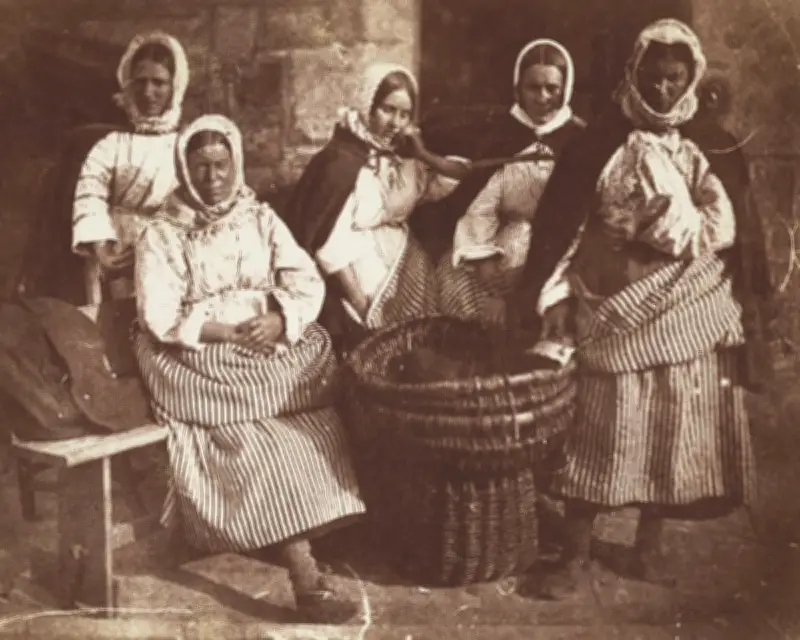
A group portrait includes Mrs Grace Ramsay and other fishwives. These women were celebrated for their beauty, confidence, and distinctive costumes. They carried great loads of fish in creels on their backs up to Edinburgh to sell directly. During a time of economic depression, high mortality, endemic illness, and potato famine in the Scottish Highlands, their provision of fresh fish was a great boon to the city.
Technical Challenges in Early Photography
One problem with early photography was capturing land without the much brighter sky overdeveloping and blanking out the image. Hill and Adamson worked with light bounced from the water. A photograph of Newhaven harbour with the paddle steamer Stirling moored by the pier, taken at full-tide possibly after rain, became too dark to see details, but the reflection of a man and the boat perched on the quay line add to the shape of the steamer.
His Faither’s Breeks
This calotype is the only one of a child standing alone. The title echoes a song: 'The soldier boy to the wars has gone / his faither’s breeks he has girded on...' The boy’s father died, leaving him with only his trousers. With no welfare state, he would have been destitute, but he is backed by a fishing boat and supported by a creel, showing the community’s embrace.
The Fishergate, St Andrews
In Fishergate, fishers worked sporadically, leading to cycles of gluttony and drunkenness followed by near starvation. Hill, Adamson, and Miss Mann photographed the area in the mid-1840s to illustrate social improvement. The central figure crossing the road with good shadow required a particular hour when sea mist did not roll in.
Children of Newhaven
The fishing series of 120-130 photographs included children and infants. One image, though technically failed, shows intelligent construction using a lobster pot and boat, materials familiar to the children.
Fishermen Ashore
A photograph of Alexander Rutherford, William Ramsay, and John Liston embodies the book’s central argument: these images constitute the first social documentary series. The photographers invented the idea while working in Newhaven, driven by aesthetic interest and admiration for a society thriving in difficult circumstances.

Willie Liston ‘Redding the Line’
Fishing required lines with 500 to 3,000 hooks, needing cleaning and bait replacement. This work was shared by men and women. Willie Liston shows extended concentration, balanced by another picture of him simply thinking, suggesting an introspective nature.
A Lane in Newhaven
This calotype is an extraordinary rendition of light, taken against the sun and surrounding the women with halos. Hill, a good singer, saw it as a lyrical photograph evoking the women’s singing voices. It belonged to marine painter Clarkson Stanfield, who said he would rather have it than the best Rembrandts he had seen.