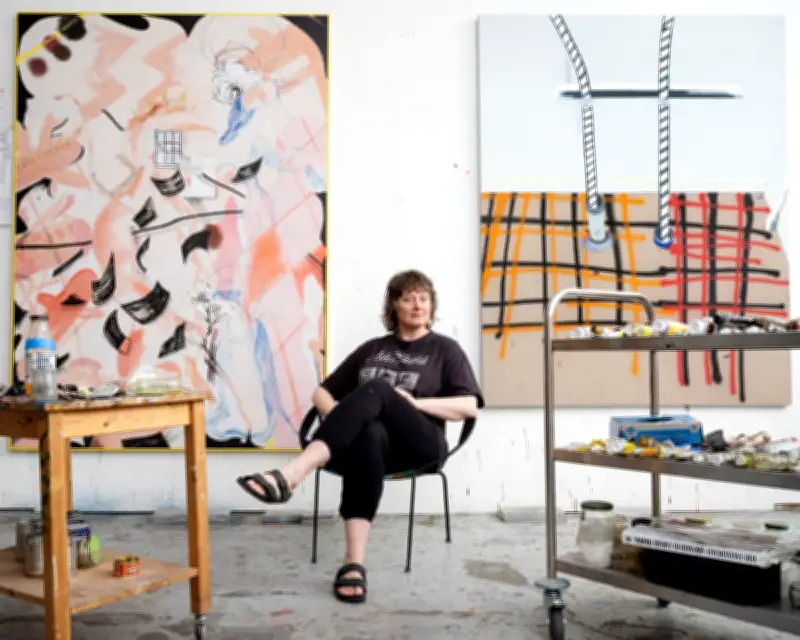
Caragh Thuring describes painting in today's world as both folly and rebellion. In her east London studio, surrounded by paintings, magazine cuttings, and cryptic notes, she reflects on creating art amid global turmoil. 'We are living through a moment of hellish, mindless destruction,' she says. Her large-scale painting Test Bed features US military airplanes flanked by bombs, with one plane transforming into a knight on a tomb, blending medieval and contemporary imagery.
A Studio of Chaos and Creation
Thuring's studio is a patchwork of influences. Born in Brussels to Scottish, Dutch, and French parents, she grew up in west Scotland, watching nuclear submarines glide through the Firth of Clyde. Her paintings feature recurring motifs: submarines, volcanoes, tartans, and brick walls. She works without preparatory drawings, letting the painting evolve organically. 'There's the idea, and then there is what actually happens when you are painting,' she explains.
The Annunciation: A Subversive Take
Thuring's The Annunciation breaks traditional rules. In this hot pink painting, one of two Marys kneels dangerously close to the angel Gabriel's lilies, while phallic cacti thrust into the scene. Leaves fall like golden rain from Zeus's transformation. The mix of styles is irreverent and witty, showing Thuring's love for stirring things up.

From Nuclear Submarines to Outer Space
A smaller sci-fi painting, Starlink, depicts Elon Musk's satellites surrounding Earth. The rocket in the painting suggests a spermatozoon fertilizing an egg, connecting cosmic themes to human intervention. Thuring's work often shows transcendent powers—a submarine surfacing, a god entering a bedroom, a volcano erupting—signaling a world about to change.
World Trade: The Mundane and the Cosmic
World Trade is based on a photograph of a nondescript office with a threadbare check carpet and electric cables. The title reminds viewers that before the twin towers were symbols of conflict, they were ordinary workplaces. Thuring's painting captures a sharp, tender shock without sensationalism. 'I'm trying to be curious, like a kid mucking around on the pavement,' she says. 'You can look at a centimetre of ground and see the whole planet.'
Connecting the Dots
Thuring's paintings are more like poetry than prose, creating spaces where different images meet. She refuses to provide clear explanations. 'People want a clear explanation. These paintings do not do that. And I do not want them to do that.' She accepts the risk of being misunderstood. 'People will read it their own way. They might think it's superficial. That's not my problem.'
Igniting Thought
Thuring's work rebels against the belief that one perspective is correct. Her paintings require viewers to think in unfamiliar ways and give up expectations of comforting messages. 'It's like little triggers or sparks or ignitions,' she says. 'That's all you can ask for: just to ignite something.' Small sparks can start a fire, and Thuring's art aims to do just that.
Caragh Thuring's exhibition is at Thomas Dane Gallery, London, until 19 September.