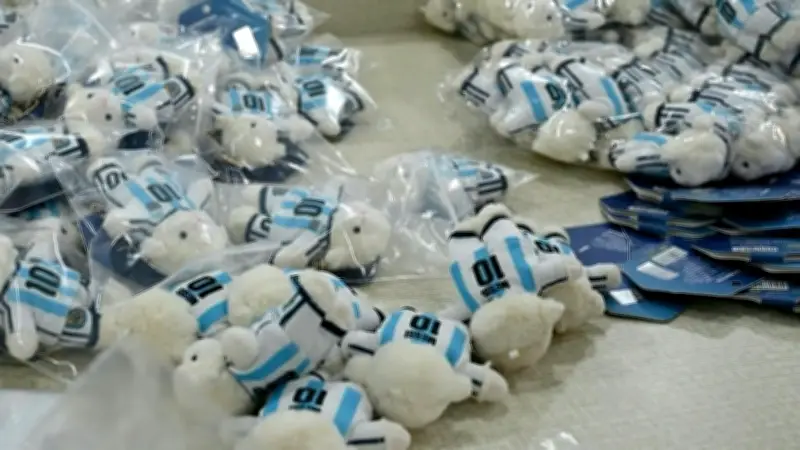
Chinese manufacturers are experiencing a boom in sales of Lionel Messi-themed plush toys during the World Cup, as fans seek emotional value in their purchases. The palm-sized soft-toy goats, dressed in Messi's Argentina number 10 shirt, are a bestseller for All Star Partner, a Chinese firm with contracts to produce branded merchandise for teams including Argentina.
Goat-Inspired Plushies Prove Popular
The toys, which pay homage to Messi's title as the GOAT (greatest of all time), are designed to be attached to bags and have seen sales increase five-fold compared to the 2022 World Cup, according to CEO Luo Bin. At the company's factory in Yiwu, China's wholesale hub, workers affix chains to the blue and white Messi goats before packaging them for storefronts across the country.
Other plushies in production include soft-toy footballers resembling Portugal's Cristiano Ronaldo, fluffy roosters in France polos, and teddy bears in Spain kits. Luo noted that the first iteration of the plush charms was a very ordinary bear, which sold tens of thousands of units after being dressed in a football kit.

Emotional Value Drives Sales
Luo admitted that the plush pendants have little practical use, but he attributed their popularity to the current economic environment. People now care a lot about emotional value, he said, adding that consumers want to buy something they truly love that makes them happy. This trend is particularly evident among young people, who are under a lot of pressure and need emotional and economic outlets, according to Fang Tian, a football fan since the 2014 World Cup.
The 79 yuan ($11.60) Messi goats are among the most popular products in All Star Partner's storefront, said influencer Zhu Hui. He noted that Chinese people are highly enthusiastic about football stars and that their enthusiasm lasts a long time. His friends are willing to stay up late to watch the games, he added.
China's World Cup Absence Doesn't Dampen Enthusiasm
Despite China's failure to qualify for the World Cup since their sole appearance in 2002, the tournament remains a boon for Chinese merchants. During the Qatar 2022 World Cup, China accounted for half of all viewing on digital and social platforms, according to FIFA. England superfan Shang Jianxing, who bought a Portugal pet carrier for a friend, believes China's football culture is at the start of becoming a way of life.
The 43-year-old from Zhejiang province has attended several World Cups and plans to travel to the United States for a semi-final match. He still hopes to see China's return to the tournament, having watched them lose 4-0 to Brazil in 2002. China lost all three group games that year without scoring a goal. Shang pointed to growing youth football programs as signs of better days ahead for the national team.
It is a pity that China has missed out on every World Cup except 2002, given football's popularity at home, he said. He believes the Chinese team will play in the World Cup again sooner or later.