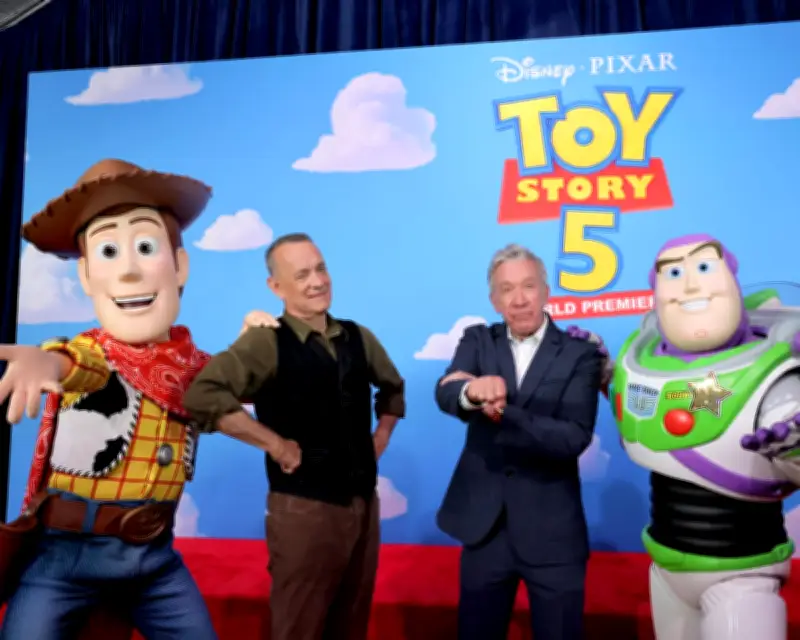
Pixar's new film, Toy Story 5, delivers a radical message: technology has stolen childhood, and parents need to wise up fast. In an interview, stars Tom Hanks and Tim Allen, along with Greta Lee and Joan Cusack, answer questions about the film's themes, parenting, and the joy of simple toys.
Learning from the New Film
Tim Allen, the voice of Buzz Lightyear, says he has learned to take about 20% less time to make a better product. 'I know now how to focus and isolate my voice. I don't do as many takes.' Tom Hanks, who plays Sheriff Woody, jokes that he sometimes asks, 'Please tell me you have it because I'm so done with this.' He adds that the importance of the work has grown, but everything else is 'just one damn thing after another.'
Hanks reflects on a story element where Jessie contacts Woody for help. 'I am not good at asking for help. So I could use that as a life lesson in this world of ours: we're not in this alone.'

Technology's Grip
Allen notes that Toy Story 5 is 'so fricking spot on' about technology. He says, 'I feel like I could rob everybody at a coffee shop and they wouldn't even know. Even the barista would just be scrolling.' He loves tech but is disturbed by algorithm manipulation, citing fake news about plane crashes. 'It says: "The 747 lands on an island in Greece sideways. All these people died." And I go: surely I would've read about this? It's just making stuff up!'
Hanks points to a moment in the film where little Bonnie's feelings are hurt by texts on the Lilypad app. 'No toy hurts your feelings if you are playing with it.' Allen adds, 'Being on a tablet is not playing with a toy. It's playing with dopamine.'
Parenting and Screen Time
Greta Lee, who voices Lilypad, says she sets clear boundaries for her children regarding screen time. 'Stepping back and refocusing and reprioritising things like time spent outside in nature. Hiking and gardening and all the good old stuff that still proves so enjoyable for the kids. Even if it's a fight. And accepting boredom – relishing boredom, and trying to counteract shrinking attention spans.'
Joan Cusack, the voice of Jessie, notes that Lee is a parent who pays attention. 'And that's the most important part. Otherwise you just let them have it because then you can do stuff.' Lee adds, 'It's not a substitute for parenting. I think it's helpful, the message in the movie. Understanding that making friends is hard and you need parents' help to do it.'
Societal Challenges
Hanks acknowledges that society is grappling with tech issues, including attempts to outlaw social media for those under 16. 'Whether or not the film alters things, it will spark conversation.' Allen recalls that when he worked in TV, there were 'standards in practice' that restricted children's access to certain content. 'Streaming has now opened that up to pornography 24 hours a day. Kids can get round parental controls. How do you pull it all back? You're not allowed to drink alcohol in the US until you're 21. I think we should let kids be kids as long as we can.'
Hanks says, 'Tech is not the additive quality to life that we assume it's going to be.' Allen reflects on human creativity: 'We are intoxicated by our own creativity. We don't care if it's a good or bad idea.' He compares it to Oppenheimer's dilemma about the atom bomb potentially igniting the atmosphere. Hanks adds, 'So we can give this thing to our children that might make them never leave their rooms and become antisocial, unempathetic beasts?'
Allen counters that tech isn't all bad. He fixed a 16th-century music box using YouTube, and Hanks' son made a wallet with gaffer tape by watching a video. 'So there's this side and there's the other side. The sick people that learn how to kill as many people as possible with a vehicle and a trash can,' Allen says. 'So the answer is it's hopeless and all up to us. And we got a 50/50 shot at setting the atmosphere on fire.'

Favorite Toys and Memories
When asked which toy they would be, Lee chooses Forky, a reanimated household object. Cusack opts for something cozy like a blanket, though Lee jokes a child would be distraught to receive a blanket as a present. Cusack suggests a soft vase or a manatee. Allen says he always wanted to be a soldier, like a GI Joe action figure, but lost interest in the figure itself. Hanks recalls a rotorcraft boomerang that was great until it landed in a tree.
Allen remembers playing with lawn darts, which were essentially two-pound steel tips with wind vanes. 'It was amazing no one got it through the middle of their heads.' Hanks notes they are now illegal by order of the United Nations.
Impact on Adults
Lee attributes the films' impact on adults to their handling of time passing. 'Anything that touches on the idea of a child that is now an adult. A toy that used to be loved that is no longer loved. That really hits home.' Allen calls the films 'honest art,' comparing them to Dostoevsky. Hanks recalls a scene in Toy Story 3 where Andy's mother stands in his empty room. 'How did this movie become so frigging profound? Often children's films deal with grief for the very first time in someone's life.'
In-Yun and Rusty Nails
Lee explains in-yun as a deep connection spanning generations. She says the in-yun between Jessie, Woody, and Buzz is strong, reflected by multiple generations of kids. Hanks reflects on making toys as a child, using a mechanical can-opener as a helicopter and rusty nails for rocket struts. 'Finding them, building them, imagining them was as much satisfaction as with any toy I ever purchased from a store.'
Snake in a Boot
When asked about the classic line 'There's a snake in my boot,' Hanks offers advice: store boots with one leg inside the other to prevent snakes, and if there is one, throw the boot far away. Allen says he is not afraid of snakes, but Hanks warns that a scorpion in a boot is a real problem.