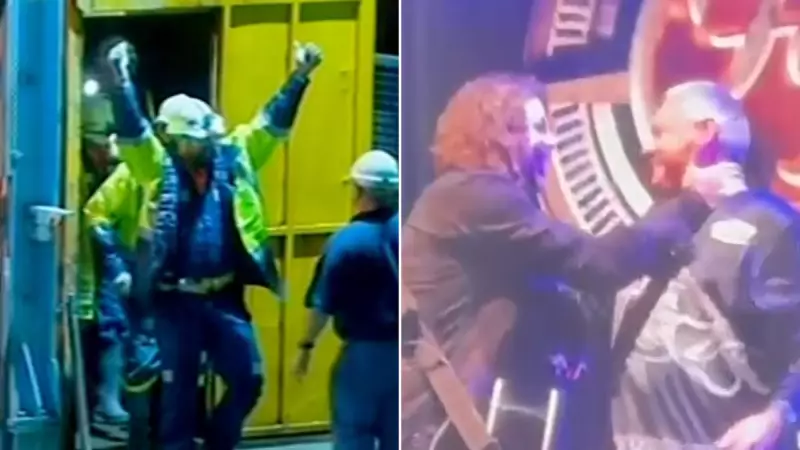
One of the survivors of the Beaconsfield mining disaster has experienced an unforgettable on-stage reunion with Foo Fighters frontman Dave Grohl, nearly two decades after enduring one of Australia's most harrowing underground ordeals.
An Emotional Encounter on Stage
Brant Webb was brought on stage during the band's encore at their sold-out Launceston concert on Saturday night, drawing a thunderous roar from the crowd of more than 25,000 fans at UTAS Stadium. The emotional moment marked almost twenty years since Webb and fellow miner Todd Russell were trapped underground for fourteen days following the catastrophic 2006 Beaconsfield mine collapse.
Music as a Lifeline During the Ordeal
During their terrifying ordeal, the pair made an unlikely request from deep below the surface—an iPod loaded with Foo Fighters songs. Speaking on Sunrise, Webb revealed that the music helped him feel connected to his wife while he waited to be rescued. "I could be with her if I could listen to the Foo Fighters," he explained, highlighting how the band's tracks provided crucial emotional support during those dark days.

Grohl told the Launceston crowd he vividly remembered first hearing the story of the trapped miners listening to his band's music, describing it as a "beautiful, profound moment." The frontman reflected, "When musicians write songs, and they go to the studio and do it, you never really consider ... the reach of it."
A Special Song for the Miners
Following the dramatic rescue operation, the Foo Fighters frontman wrote an instrumental track titled The Ballad of the Beaconsfield Miners, first performing it for Webb and Russell at the Sydney Opera House. On Saturday night, Grohl played the song again in a special acoustic performance, this time in front of tens of thousands of Tasmanian fans.
Webb called the moment "pretty special," adding, "The roar was amazing. I've never experienced anything like that before." He described the experience as deeply emotional, especially given he never expected the song to live on beyond its first performance. "When he first did it at the Opera House, we thought it would be a one-off, but he promised he'd put it on the album, and he did," Webb said. "What a champion... It was really special for us."
Reflections on Recovery and Time
Webb attended the concert alongside his wife and family, but with accommodation in Launceston fully booked, he brought his yacht down from Beauty Point and completed his Sunrise interview live from the boat. The former miner, who now runs a property maintenance business, said figures like Grohl played an important role in his recovery after the rescue. "All my rescuers are my heroes," he stated. "It doesn't matter if they rescued your body or your mental health."
Reflecting on the upcoming twentieth anniversary of the Beaconsfield disaster in April, Webb said the passage of time felt surreal. "It's amazing how fast time goes," he observed. "It's like it was yesterday, really. In big events, time stands still." He added with a touch of humor, "I've got a lot greyer."
The Lasting Impact on Grohl
Grohl has repeatedly spoken about the impact the Beaconsfield story had on him personally, telling Triple M the moment he learned his music had helped the miners endure underground changed how he viewed songwriting. "To hear that someone on the other side of the planet finds comfort in a song that you've written was a huge revelation for me," he said, acknowledging how the experience deepened his understanding of music's power.
The Foo Fighters flew into Tasmania for just forty-eight hours to perform the one-off stadium show, making the reunion even more significant for both the band and the mining survivor. This remarkable story continues to resonate, demonstrating how music can bridge unimaginable circumstances and create lasting connections across decades.