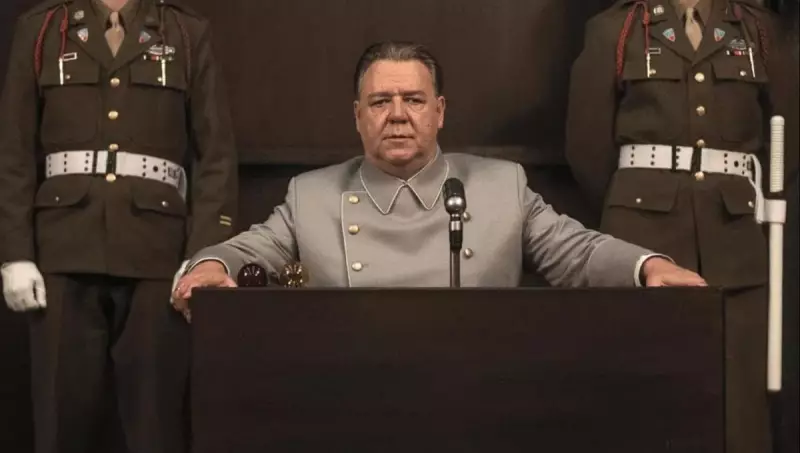
Academy Award-winner Russell Crowe spearheads a compelling dive into post-war history with the new film Nuremberg, a dramatic retelling of the famous trials of top Nazi officials. Released in cinemas now, the movie features Crowe in a transformative and critically acclaimed performance as Reichsmarschall Hermann Göring.
Crowe Commands the Screen as a Complex Göring
The film, directed by James Vanderbilt and based on Jack El-Hai's 2013 book The Nazi And The Psychiatrist, opens in the chaotic final days of World War II. It captures the moment Göring's car is intercepted by American forces in Austria, a day after Hitler's suicide. Crowe fully embodies the notorious figure, portraying him not as a one-dimensional monster but as a highly intelligent, vain, and dangerously charismatic leader.
Critics and audiences alike are noting the actor's deft handling of these contrasts, occasionally even eliciting a twisted sympathy for the man who was second-in-command to Hitler. The performance is already being hailed as a career highlight for the Australian star, with many agreeing it's difficult to imagine another actor in the role.

A Tribunal Built from Scratch
The narrative quickly shifts to the United States, introducing Supreme Court Justice Robert H. Jackson, played with gravitas by Michael Shannon. Jackson passionately argues for a legal trial over summary execution, believing a public accounting under the law is the only way to prevent future atrocities and avoid creating martyrs.
His vision leads to the creation of the first-ever international war crimes tribunal in Nuremberg, a court established with no direct legal precedent. Into this unprecedented setting enters US Army psychiatrist Dr. Douglas Kelley, portrayed by Rami Malek. Kelley's mission is to assess the mental state of the imprisoned Nazi leaders, including Göring, and prevent them from following Hitler's example by taking their own lives.
Psychological Warfare and Authentic Horror
The core of the film becomes a fascinating series of intellectual duels between Kelley and Göring. The psychiatrist strives to understand how a man of such apparent capability could rationalise the regime's unspeakable crimes. Director Vanderbilt employs a powerful technique to underscore these horrors, using authentic archival footage from the actual trials.
The actors' reactions to this footage were captured live on camera, resulting in raw and authentically pained responses that heighten the film's emotional impact. While the movie draws surface-level parallels to modern themes of rising authoritarianism, particularly relevant to current American politics, it largely avoids delving into deeper contemporary allegories.
A Compelling, If Flawed, Historical Epic
Some critiques of Nuremberg point to a runtime that could benefit from being trimmed by roughly 30 minutes. However, the powerhouse central performance by Crowe, supported by strong turns from Leo Woodall and John Slattery, ensures the drama remains gripping through to its conclusion.
Rated M for mature audiences, Nuremberg is now showing in Australian cinemas, offering a stark, actor-driven exploration of one of history's most pivotal attempts to deliver justice.