Joel Carrett Cartier, ‘the jeweller of kings’, has come to the NGV in a dazzling new exhibit. Published: June 12, 2026 6.10am AEST. Founded in Paris 179 years ago, Cartier has fostered a legendary reputation as the creator of luxury goods for royalty, the aristocracy, film stars, and the generally wealthy. The English king Edward VII famously referred to Cartier as “the jeweller of kings and the king of jewellers”. The glittering magnificence of the Cartier style through the ages has been brought together in a major exhibition by London’s Victoria and Albert Museum, now being presented at the National Gallery of Victoria.
An Instant Hit
Curated over almost a decade by the Victoria and Albert Museum’s Helen Molesworth, the Cartier show opened in London last year for a seven-month season and promptly sold out. With almost 350 items on display, it was celebrated by many as one of the best shows of 2025. However, one criticism was the exhibition was too cramped, and the inevitable small scale of most of the objects resulted in a crowd crush within darkened spaces. The NGV iteration of the exhibition, with almost 400 items, presents a number of alterations to the checklist of exhibits, such as the inclusion of necklaces and bodice ornaments owned by Australian opera singer Dame Nellie Melba. Melba was an early client of the brand, with Pierre Cartier among her fans.
More significantly, the NGV has collaborated with internationally renowned designers to reimagine the exhibition, following in a tradition it has established for itself over several years. The gallery has collaborated with Studio Sabine Marcelis and CLOUD, two multidisciplinary design practices based in Rotterdam, in The Netherlands. Marcelis evokes the Cartier colour palette in her design, while CLOUD has built on the Cartier geometric forms to create light-filled architectural structures that are involved in a creative dialogue with the jewellery.

A Thumbnail Sketch of Cartier’s Style
The thumbnail sketch of the development of the Cartier style is mandatory for understanding the exhibition. Louis-François Cartier founded the firm in Paris in 1847, and in 1874 passed it to his son Alfred. It was Alfred’s three sons – Louis, Pierre and Jacques – who internationalised the brand and made it into a powerhouse of fashion design, with offices in Paris, London, New York and St Petersburg. Louis embraced orientalist Art Deco designs and colourful “Tutti Frutti” jewel combinations. He also pioneered wristwatch designs and exploited platinum as a structural base for elaborate diamond and gemstone settings in the jewellery. Pierre extended operations to New York, while Jacques developed operations in New Bond Street in London.
It is difficult to define the Cartier design, yet relatively simple to recognise it when you encounter it. Writing in the NGV Cartier catalogue, Vivienne Becker, a prolific London-based jewellery historian, arrives at a convincing characterisation. She writes that the style: is underpinned by culture, by an ever-evolving quest to infuse jewellery design with originality, artistic integrity and cultural richness. As one makes their way around the exhibition, there is constant encounter with styles from the past – including Egyptian, Chinese, Japanese, Iranian and Islamic elements – informing the use of diamonds and other precious materials.
A Who’s-Who List of Clients
Cartier also has its repertoire of signature motifs, such as the iconic Panthère, which may appear as a panther clip brooch, or snakes and crocodiles that can take the forms of necklaces and bracelets. The exhibition includes many of the brand’s signature animal motifs. As jewellers and watchmakers, Cartier was known as the “watchmaker of shapes” – exploiting squares, rectangles and octagons, rather than the traditional circle. While celebrating a supreme elegance, most of the items on display have the power to surprise, such as a spectacular scarab brooch, or a 1933 brooch with a giant floating amethyst set against sapphires, diamonds and platinum.

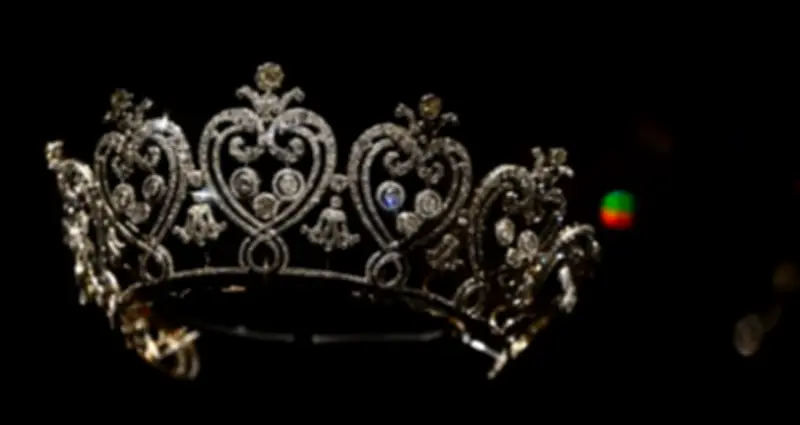
A highlight of the exhibition is the display of more than 20 stunning tiaras. These are symbols of royalty and glamour, with connotations of celestial halos, laurel wreaths and garlands. These tiaras have been worn by a who’s who of celebrities. For instance, one scroll tiara (1902) was worn by Clementine Churchill at the coronation of Queen Elizabeth II in 1953, and again in 2016 by the singer Rihanna, on the cover of W magazine. There is also the Sun tiara of 1907, with a 32-carat cognac-yellow diamond at its core, and the Art Deco diamond and platinum Halo tiara of 1934, which was inspired by ancient Egypt and owned by Begum Aga Khan III. Household names who have worn the Cartier jewellery present in this exhibition include Elizabeth Taylor, Grace Kelly, Rihanna, Princess Margaret, The Duchess of Windsor, Dame Nellie Melba, the Maharaja of Patiala, Begum Aga Khan III and American heiress Barbara Hutton. These will prove a selfie magnet for many visitors.
While this is not the first major Cartier exhibition in Australia (there was a big show in Canberra in 2018), it is the largest, containing almost 300 items never previously seen in Australia. It is also the most innovative in its display. Cartier continues to resonate with its audiences by going beyond mere displays of ostentatious wealth; it taps into ancient cultures and traditions, making them modern and relevant to contemporary audiences. There’s a whole catalogue of luminaries and household names of wearers of the Cartier jewellery present in this exhibition. Cartier is showing at the National Gallery of Victoria from June 12 to October 4.