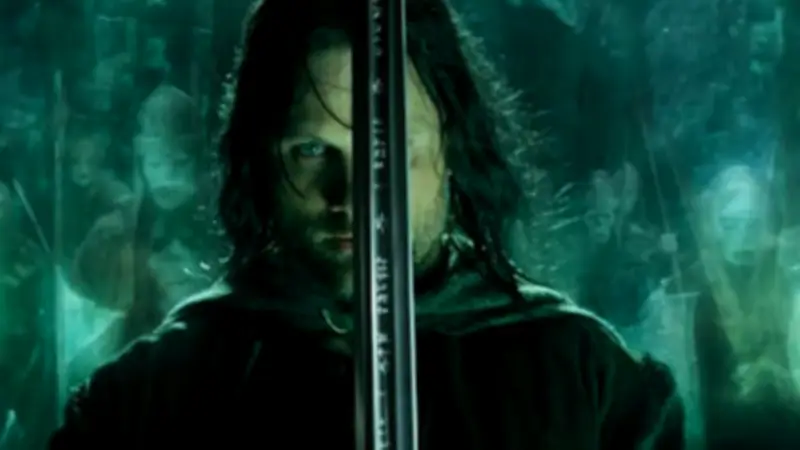
In late 2025, the U.S. Department of Homeland Security posted a meme featuring Merry Brandybuck from The Lord of the Rings, warning Pippin that there will be no Shire unless he joins the fight, overlaid with the words "JOIN.ICE.GOV." This sparked a wave of Tolkien-themed anti-immigration memes, reflecting a broader trend among Silicon Valley elites like Elon Musk, J.D. Vance, and Peter Thiel to co-opt Tolkien's heroic good-versus-evil imagery for New Right rhetoric. However, scholars argue that such readings fundamentally misrepresent Tolkien's work, which is deeply skeptical of power and domination.
The Shire and the Scouring
The Homeland Security meme does not align with Tolkien's book. In The Two Towers, the Ents decide independently to attack Saruman after careful deliberation, not due to hobbit persuasion. The book's penultimate chapter, The Scouring of the Shire, depicts the Shire being taken over by ruffians and hobbit collaborators who impose rules and curfews, using Orwellian language like "gathering and sharing" to mask theft. Scholars like David M. Waito emphasize that this threat is internal, stemming from the same hunger for power that the adventurers resisted in Mordor. The hobbit collaborators, such as Ted Sandyman and Lotho Sackville-Baggins, are suspicious of nonconformists like Frodo Baggins. Lotho, a capitalist mogul, seeks to own everything and order others around, echoing Tolkien's critique of unchecked ambition.
Palantir and the Palantiri
Tolkien's suspicion of power is central to his work. In 1943, he wrote to his son about leaning toward "Anarchy (philosophically understood, meaning abolition of control)." The Shire's utopian social system, where the only government official is a mayor who presides over banquets, reflects this ideal. Silicon Valley figures like Peter Thiel, who named his surveillance company Palantir after Tolkien's seeing stones, claim affinity with this anarchic utopianism. Thiel argues that dangerous technologies should be controlled by individual entrepreneurs, not governments. However, Tolkien's palantiri have a darker history. Crafted by the Noldor, including the tragic hero Fëanor, they symbolize the dangers of invention without restraint. Fëanor's fatal flaw is his love of invention, leading to the elves' exile. In The Lord of the Rings, users of the palantiri—kings of Gondor, Saruman, and Denethor—fall into isolation, secrecy, and despair. Tolkien's message is that power wielded in secret and without accountability leads to destruction.

Tolkien and the Machine
Silicon Valley's philosophy, as articulated by Thiel, frames the world as a battle between unquestioned good and unexamined evil. Thiel's heterodox Christianity sees opposition to technological advancement as the Antichrist, leading to a totalitarian world state. In contrast, Tolkien defines the "Machine" as any external device used with the corrupted motive of dominating others. Evil can spring from a desire to benefit the world according to one's own plans. In the end, Frodo tells Sam that even the Shire has become Mordor, as Saruman's work was always aligned with evil. For Tolkien, any place can become Mordor when the desire to benefit others turns into domination.
Misreading Tolkien
While Silicon Valley readings tap into Tolkien's anarchic utopianism, they miss his nuanced moral universe. W.H. Auden criticized Tolkien's depiction of absolute evil in orcs, fearing it encourages identifying our cause with good and our enemies with evil. Tolkien himself intended good and evil as absolutes to illuminate their nature: goodness is humble and serves others, while evil is competitive and seeks control. Silicon Valley's heroic narrative of entrepreneurs saving the world through technology overlooks Tolkien's warning that even noble intentions can lead to domination when power is unchecked. Thus, the misreading of Tolkien by Silicon Valley is not just a misunderstanding of a literary work but a reflection of a worldview that ignores the dangers of power and the importance of humility.