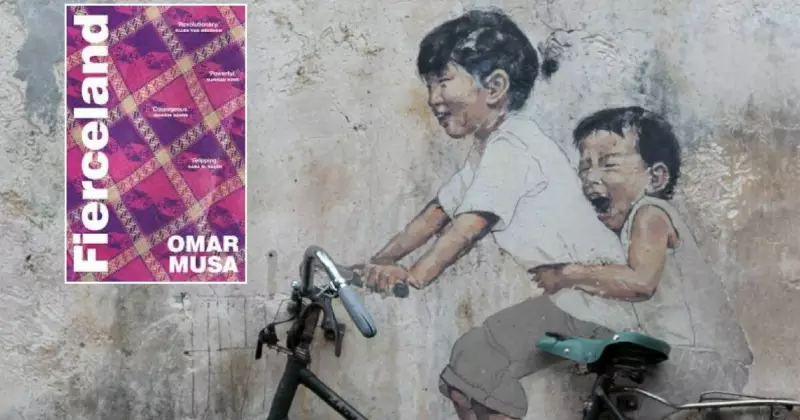
Omar Musa's Fierceland: An Epic Australian Novel Blending Family Saga with Environmental Morality
Omar Musa's latest literary offering, Fierceland, represents a monumental undertaking in contemporary Australian fiction. Spanning five distinct geographical regions and covering approximately 170 years of history, this ambitious work employs at least ten different narrative perspectives while seamlessly integrating prose, poetry, and visual art elements. The novel stands as a significant contribution to what many critics have identified as a growing trend toward grandiosity and scale in Australian literature.
A Literary Response to Contemporary Crises
Recent years have witnessed Australian authors embracing increasingly ambitious literary projects, with Alexis Wright's Praiseworthy serving as a prominent example of this shift toward epic storytelling. This movement toward grander narrative scope appears particularly suited to our current era of polycrisis, characterized by ecological collapse, widening inequality, and various humanitarian catastrophes. As critic Northrop Frye once observed regarding John Milton's Paradise Lost, sometimes the true genius lies not in execution but in the sheer ambition of the thematic undertaking.
Fierceland emerges as perhaps the first Australian or Australian-adjacent work to directly engage with Wright's literary challenge. Musa consciously positions himself within the tradition of epic writers from the Global South, drawing inspiration from literary giants including Gabriel García Márquez, Chinua Achebe, and Salman Rushdie. The novel incorporates the Malay concept of Hikayat, a traditional folk epic form celebrating heroic deeds, while centering around an ambitious "Song of the Forest" project that Musa has translated into numerous local languages from Malaysia's Sabah and Sarawak regions.

Balancing Epic Scope with Intimate Character Portraits
Despite its sweeping historical and geographical canvas, Fierceland remains deeply invested in the personal fortunes and psychological complexities of its characters. The narrative follows the individual fates of family members including father Yusuf, mother Jenab, aunt Nurhanizah, uncle Hamid, henchman Jibrail, and upriver worker Salam. These multiple perspectives converge through the experiences of children Rozana and Harun, framed by the poetic interjections of a speaking forest that serves as both structural anchor and moral compass.
The novel's tension between epic breadth and novelistic intimacy creates both its greatest strengths and most significant challenges. As an epic, Fierceland achieves remarkable chorality through its fragmented narrative voices, with Musa demonstrating impressive stylistic versatility as he modulates prose between characters. From Rozana's drug-influenced hypotaxis to Harun's staccato observations and uncle Hamid's lyricism, each character possesses a distinctive linguistic identity reminiscent of James Joyce's narrative techniques.
Historical Narrative and Environmental Allegory
Through its polyphonic perspectives, Fierceland traces Malaysia's complex journey toward modernity, examining regional disparities, ethno-nationalism, and political corruption. The character of patriarch Yusuf embodies the synthetic nation's borrowing from other postcolonial success stories, with his journey to Nigeria serving as a thinly-veiled narrative about the introduction of oil palm cultivation to Asia.
The speaking forest of north Borneo provides the novel's moral center, operating similarly to Wright's concept of "Country" in Praiseworthy as an overwhelming perspective against which all human stories are judged. However, this environmental allegory presents certain difficulties, as the forest's voice sometimes settles moral questions too definitively, leaving little room for the nuanced ethical perplexities typically explored in literary fiction. The imperative to preserve Borneo's wilderness overshadows other considerations, creating a moral transparency that occasionally undermines character complexity.

Stylistic Challenges and Literary Ambition
Fierceland occasionally struggles to balance its urgent narrative pace with meditative poetic moments, while certain historical details and character portrayals reveal tensions between epic and novelistic conventions. The depiction of Harun as a tech entrepreneur and Rozana as a visual artist sometimes feels insufficiently developed, and the novel's use of supernatural elements wavers between hallucination, virtual reality, and poetic expression without achieving collective significance.
The novel's central drama plays out between two competing impulses: the political epic outlining global systems, and the psychological novel examining modern malaise and trauma. This tension manifests in how the narrative dampens moments of intense action with reflection while rendering characters' inner turmoil almost insignificant from historical perspectives.
A Reckoning with Literature's Contemporary Role
Perhaps most intriguingly, Musa appears consciously aware of these literary stakes, questioning whether personal narratives can adequately address historical wrongs or whether they merely represent another attempt to individualize systemic problems. This self-awareness creates a fascinating metafictional dimension, suggesting that Fierceland might deliberately set up its personal narratives only to reveal their limitations in confronting political realities.
The novel ultimately demonstrates literature's potential inadequacy in an age of polycrisis, while simultaneously pushing against those limitations through sheer ambition. Despite occasional miscalculations in style and detail, Fierceland represents a tenacious reckoning with impossible situations, with its "Song of the Forest" alone elevating the work beyond conventional Australian literary orbits. Musa's ambitious undertaking may not fully succeed by its own monumental standards, but in this respect it joins other major contemporary works attempting to confront modern political complexity through literary means.