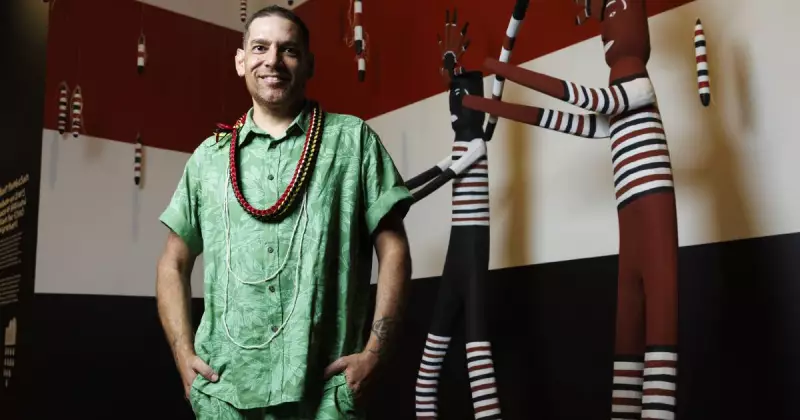
It's a rare moment when a major gallery exhibition arrives in the mind of its curator, fully formed and ready to be shared. For the National Gallery of Australia's fifth Indigenous Art Triennial, that moment came when acclaimed contemporary artist Tony Albert walked into a meeting in 2023, armed not with vague ideas, but with a single, overflowing black notebook.
A Vision Fully Formed
Gallery director Nick Mitzevich had anticipated a preliminary discussion about the upcoming triennial, for which Albert had been selected as curator. Instead, he was presented with a remarkably clear and detailed series of concepts, all meticulously laid out in the artist's personal journal. This unexpected presentation set the stage for what would become a landmark exhibition.
The Queensland-born multimedia artist envisioned a completely artist-led event. His concept for the triennial's fifth iteration focused on ten distinct installations, each exploring powerful themes of renewal, resistance, and rebirth. The final result is a bold, bright, and exuberant showcase that captures the dynamic spirit of the Indigenous art world today—characterised by its edge, unexpected beauty, and profound narratives.

After the Rain: A Metaphor for New Growth
Opening to the public on Thursday, December 5, the exhibition is titled 'After the Rain'. Albert describes this name as a powerful metaphor for the ongoing exploration of country and culture. "After the rain, the land is cleansed, seeds begin to sprout, and new life emerges," he explained at the launch.
The exhibition begins with a series of portraits by the celebrated artist Vincent Namatjira, featuring each of the participating creators. The impressive lineup includes:
- Aretha Brown
- Alair Pambegan
- Dylan Mooney
- The Hermannsburg Potters
- Thea Anamara Perkins
- Blaklash Collective
- Troy Casey
- Amanda Hayman
Together, their works—spanning bark paintings, watercolours, sculpture, and large-scale installations—weave a compelling story of First Nations art. They trace its deep roots, examine its current inspirations, and offer a glimpse into its exciting future.
An Artist's Full-Circle Journey
For Albert, this exhibition represents a significant personal and professional milestone. He recalled attending the very first Indigenous Art Triennial at the NGA in 2007 as a starry-eyed art student from Queensland. "I was a student, I saved up my pennies," he said. "I was bright-eyed and bushy-tailed."
His journey came full circle when he was featured as an artist in the 2012 and 2017 triennials. Now, he has made history as the first artist appointed to curate the event. He describes organising 'After the Rain' as the biggest project he has ever completed, albeit in a curatorial rather than artistic capacity.
"There's something quite melodic about it," Albert reflected on the interconnected exhibition spaces filled with diverse works. "[It's] really pushing the limits of what conceptual Indigenous art really is. The span of all that was very important in my thought process... It's about what has come before us, where we currently sit, and what the future holds. The time is now."
He emphasised his desire for visitors to appreciate the incredible evolution of the Indigenous art world, even within recent decades. "Australia is leading the global push towards First Nations recognition," Albert stated. "We are penetrating walls that have not been broken yet, and it's been done in the most fantastic, generous, Indigenous-led way."
While Albert does not have his own artworks in the triennial, his original black notebook—the catalyst for the entire exhibition—is displayed in a glass case. The exhibition's catalogue, richly illustrated and bound in black, is a direct homage to that seminal object.
'After the Rain' opens at the National Gallery of Australia in Canberra on December 6, 2025, and will run until April 26, 2026. It stands as a testament to the power of a single idea, captured in a simple notebook, to blossom into a national celebration of Indigenous artistic vision.