Newcastle Quantum Researcher Honoured on UNESCO's Global Top 100 List
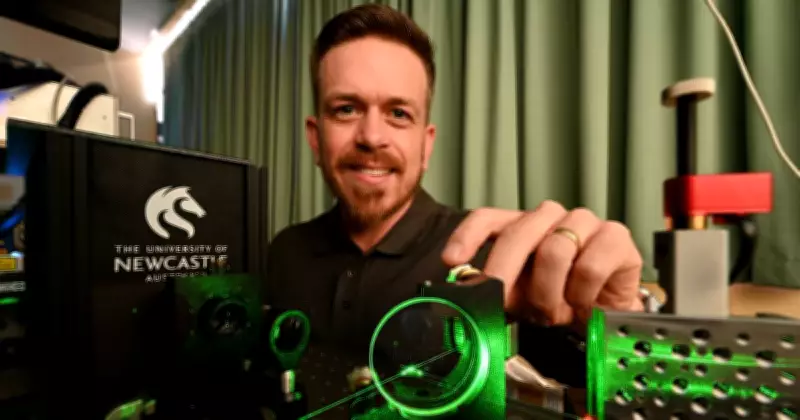
When Dr Lachlan Rogers first embarked on his journey into quantum science, he often found himself met with blank stares from friends and family as he attempted to explain his complex field of study. "I'd watch their eyes glaze over instantly," he recalls with a smile. Now, two decades later, the University of Newcastle lecturer has developed a more accessible explanation for his pioneering work: "I shine lasers at diamonds to make them glow."
This simple description belies the profound significance of Dr Rogers' research, which has earned him a prestigious place on a global list of 100 top quantum researchers. The recognition comes as part of a United Nations Educational, Scientific and Cultural Organisation (UNESCO) initiative celebrating a century of quantum mechanics study.
A Humbling Recognition
"It's a huge privilege and it's a pretty high recognition indeed, and I feel a bit humbled by it," Dr Rogers said of the honour. His research focuses on using laser light to stimulate atoms that exist as impurities within diamonds, causing them to emit light. For quantum scientists, this process represents a remarkable breakthrough because it enables researchers to effectively "talk and listen" to individual electrons.

This capability opens up extraordinary possibilities for creating ultra-sensitive sensors and devices capable of measuring phenomena at previously unimaginable scales. "The idea that we can actually meaningfully control matter, one electron at a time, is really profound to me," Dr Rogers explained. He often jokes with his students that "anyone can talk to an atom, the hard part is being able to understand when they answer you back."
Building Blocks for Quantum Computing
While glowing diamonds might seem far removed from everyday technological applications, Dr Rogers emphasises they represent fundamental building blocks for quantum computing – a field he describes as potentially "a total game changer." Unlike conventional computers that might be replaced for every purpose, quantum computers will enable entirely new computational capabilities.
Quantum computing promises revolutionary advancements in several critical areas:
- Developing new encryption methods and secure internet codes
- Accelerating biomedical research and drug discovery
- Enabling sophisticated simulations of molecular behaviour
Dr Rogers notes that current biomedical investigations, such as those for vaccines or cancer treatments, largely rely on trial and error approaches. Quantum computing could transform this process by allowing scientists to run detailed simulations of new biomedical technologies and gain deeper understanding of molecular interactions within the human body.
Diamond's Unique Advantages
Among various materials being explored for quantum computing applications, diamonds offer a distinct advantage: they function effectively at room temperature. Dr Rogers is currently investigating the quantum properties of different impurity atoms within diamonds, as well as atoms in novel nano-scale sheet materials.
His ultimate research goal involves identifying systems that serve as superior building blocks for quantum computers, with particular focus on how long these systems can reliably store quantum information. "Quantum information devices already exist, but they don't yet exist as a commercially viable new technology," he observes. "They are not yet cracking the encryption codes or letting us theoretically model the shape of protein molecules."
From Laboratory to Public Engagement
Dr Rogers' journey into quantum science began during his university years when a researcher invited him to tour their laboratory. "I was just hooked," he remembers. Beyond his laboratory work, he maintains a passionate commitment to public science education.

In 2018, he organised a cross-country road trip from Sydney to Perth where scientists visited regional schools to discuss their research. This initiative has evolved into an annual event during National Science Week. "We were talking to kids that hadn't really thought much about the idea of studying at university, let alone studying science," Dr Rogers said. "They are walking out of the classroom with some of them thinking for the first time, maybe I could dream that dream."
As quantum technologies approach wider implementation, Dr Rogers believes the field's progress depends less on scientific breakthroughs and more on investment and entrepreneurial development. His UNESCO recognition not only celebrates individual achievement but highlights Australia's growing contribution to one of science's most transformative frontiers.