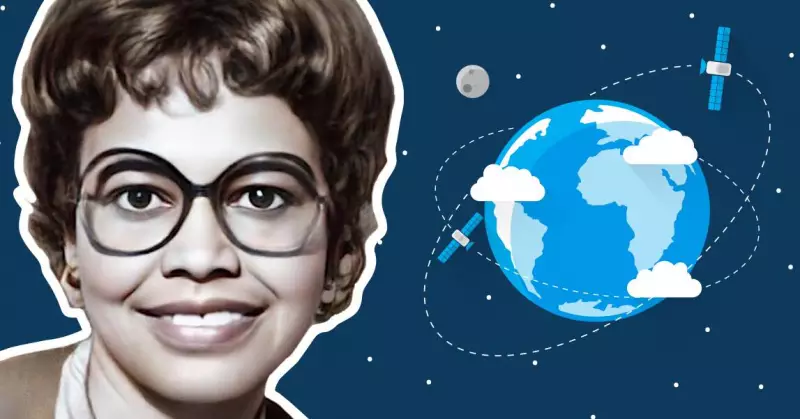
The Mathematical Mind That Shaped Modern GPS
From the vastness of space, our planet appears as a smooth, serene sphere – the iconic 'Blue Marble' observed by astronauts. Yet, this celestial view belies the intricate complexities that define Earth's true form, complexities that became the life's work of a pioneering mathematician named Gladys West.
Beyond the Perfect Sphere: Earth's True Geometry
While Mount Everest stands as Earth's highest peak at nearly 10 kilometres, it represents merely a minor surface irregularity on our planet's expansive 12,756-kilometre diameter. This perspective shifts dramatically when precision navigation enters the equation.
Historical scientific giants Isaac Newton and Christiaan Huygens theorised that Earth isn't a perfect sphere but rather an oblate spheroid – flattened at the poles and bulging at the equator. This geographical reality means our planet measures approximately 42 kilometres wider at the equator than from pole to pole.

These planetary irregularities create significant challenges for satellite-based positioning systems. For Global Positioning System (GPS) technology to function with reliable accuracy, mathematical models must account for Earth's gravitational variations and topographical features rather than assuming a uniform spherical shape.
Gladys West: From Rural Virginia to Naval Mathematics
Gladys West, who passed away on January 20, 2026 at age 95, dedicated her career to solving these complex geographical puzzles. Born in 1930 in the racially segregated American South, West's early life involved agricultural work on her family's Virginia farm and lengthy walks to a one-room schoolhouse.
Her educational journey began with plans to study home economics, but West's mathematical talents soon revealed themselves. After discovering geometry, she earned a scholarship to Virginia State College, where her intellectual abilities flourished.
Following graduation, West taught mathematics and science in segregated schools before pursuing advanced studies. She earned a master's degree in mathematics, then joined the U.S. Navy at the Naval Proving Ground in Virginia – an opportunity made possible by President Dwight Eisenhower's 1955 ban on racial discrimination in federal hiring.
Pioneering Computational Mathematics for Navigation
At the Naval Proving Ground, West embarked on a mission to develop mathematical models that could accurately represent Earth's gravitational anomalies. Her work involved calculating the effects of various planetary bulges, including those caused by tidal forces.
The computational challenges were substantial. Working with primitive early computers, West manually coded algorithms using punched cards containing binary data (zeros and ones), feeding these into machines that occupied space equivalent to modern buses.
Her mathematical contributions became foundational to modern GPS technology, enabling the precise navigation we now take for granted – from driving between Australian cities without detours to global positioning applications across countless industries.
Ironically, West herself rarely used GPS technology, preferring traditional maps for navigation. Her legacy, however, ensures that millions worldwide can navigate with unprecedented accuracy, thanks to her mathematical insights into our planet's true form.
The Fuzzy Logic Science Show continues to explore scientific questions each Sunday at 11am on 2xx 98.3FM, inviting audience inquiries about mathematics, technology, and scientific discovery.