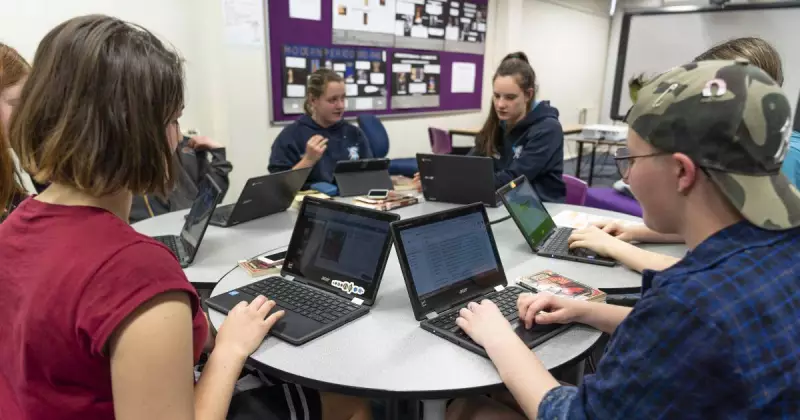
Students attending ACT government schools currently face restrictions on accessing generative artificial intelligence tools through their school-issued Chromebooks, sparking debate about whether this technological gap could disadvantage them compared to students in other jurisdictions.
The AI Access Divide Between ACT and NSW
While ACT government students cannot utilise AI tools on their educational devices, their New South Wales counterparts have been benefiting from NSWEduChat since 2025. This generative AI platform operates within a dedicated cloud environment located in Sydney and has been specifically designed to cater to the NSW educational context.
The NSW program underwent trials in 2024 before being rolled out to all teaching staff during the second semester. By 2025, students from Years 5 through 12 gained access to this innovative educational resource.

ACT's Cautious Approach to Classroom AI
Within ACT schools, staff members have participated in trials involving two prominent AI systems: Google's Gemini and Microsoft's Copilot. According to official reports, all teachers currently have access to Google's Gemini, which they can employ both to educate students about artificial intelligence and to support workload reduction and enhance work efficiency.
Although it is understood that students will eventually gain access to these tools, the timeline for this implementation remains unclear, creating uncertainty about when ACT students might bridge this technological divide.
The Impossible Task of AI-Proof Assessments
University of Canberra education lecturer Dr. Beth Chapman has highlighted the significant challenges educators face in creating assessments that cannot be completed with AI assistance. "It's really difficult to create assessments that are AI-proof. It's impossible, actually," Dr. Chapman stated emphatically.
She further explained that once students complete their formal education and enter the workforce, they will be expected to possess proficiency with AI tools, given the technology's proven capacity to deliver efficiency gains and improved accuracy across numerous professional fields.
Redesigning Educational Assessments for the AI Era
Dr. Chapman advocates for a fundamental shift in assessment design rather than attempting to police AI usage. "What AI has done has essentially highlighted the fact that many of our assessments were poorly designed and poorly aligned with the content that was being taught and not representative of real-life situations," she observed.
The education expert suggests assessments should increasingly focus on what students need to accomplish independently, while acknowledging that in professional environments, many tasks will realistically be completed with AI assistance. She draws parallels with advancements in medical technology, where professionals no longer perform certain manual tasks but instead rely on technological tools to enhance accuracy and efficiency.
"The practical stuff [will remain], AI can't take a blood sample and AI can't install a toilet," Dr. Chapman noted, emphasising that human skills will continue to be essential even as AI becomes more integrated into professional workflows.
Academic Integrity in the Age of Generative AI
The ACT Board of Senior Secondary Studies has established guidelines addressing AI usage in assignments and assessments, providing advice to teachers, parents, and students. A government spokesperson confirmed that these guidelines encourage schools to balance authenticity and integrity in assessment tasks.
Some ACT non-government schools have already begun creating AI-enabled assessments, reflecting a more progressive approach to incorporating this technology into educational practices.
Moving Beyond Punishment to Educational Adaptation
Dr. Chapman argues that schools should transition away from penalising students who use AI and instead concentrate on redesigning assessment approaches. She acknowledges that cheating has presented challenges for educators for decades, noting that generative AI simply makes dishonest practices more accessible to students inclined toward academic misconduct.

However, the education lecturer maintains that most students genuinely want to do the right thing, with cheating typically resulting from external pressures such as time constraints, parental expectations, or other factors that make students feel dishonest practices represent their only viable option.
"[AI is] pushing us to a place where we have to understand, we need to embed AI in what we do," Dr. Chapman concluded, emphasising the inevitable integration of artificial intelligence into educational frameworks and professional environments alike.