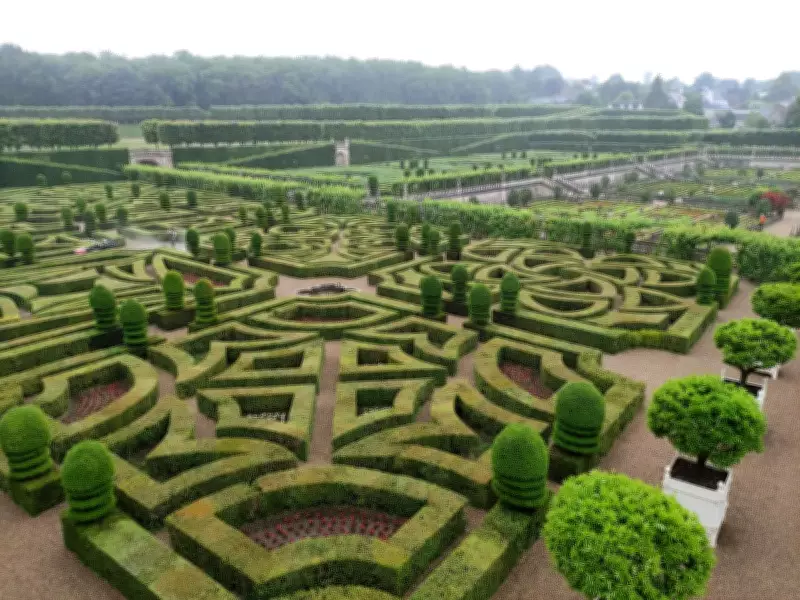
A French Garden to Behold: Villandry's Stunning Renaissance Revival
On a grey, drizzly morning in June, I found myself hesitant to disembark from our coach as we arrived at yet another chateau in France's picturesque Loire Valley. Having already explored several grandiose country estates under sunnier skies in recent days, the prospect of another visit in such unseasonably dreary weather left me feeling somewhat reluctant. However, each chateau on our itinerary holds its own unique stories and special charms, and the Chateau de Villandry proved to be no exception.
Embracing the Gardens in the Rain
Despite the damp conditions, we opted not to venture inside the 16th-century palace itself. Instead, we raised our umbrellas and immersed ourselves in the estate's crowning jewel: its fabulous gardens, which span approximately 6 hectares in the village of Villandry, nestled by the River Cher, a tributary of the Loire. With an official audio guide directing us to key areas and vantage points, we learned about the estate's rich history. Originally developed in the 1530s by Jean Le Breton, finance minister to King Francois I, the property has changed hands and been modified numerous times over the centuries.
Since 1906, the Carvallo family has owned the chateau. The current owner, Henri, is the great-grandson of Dr. Joachim Carvallo, a Spanish-born scientist, and Ann Coleman, an American steel heiress. Driven by a deep passion for history and horticulture, this couple embarked on an ambitious project to restore both the chateau and its gardens to their former Renaissance splendor.

A Geometric and Allegorical Masterpiece
From the elevated belvedere, visitors can enjoy a superb overview of the gardens, fully appreciating their intricate geometric and arabesque designs. The themed gardens feature allegorical box beds shaped like daggers, flames, and hearts, symbolizing love and its contrasting emotions, from tenderness to tragedy. Meanwhile, fruits, herbs, and vegetables are flamboyantly planted, adding bursts of color and life to the landscape.
As I ambled beneath my umbrella, the serene sounds of birdsong and distant church bells from Villandry village filled the air. We were nearly alone in the gardens, apart from the dedicated staff who were busy spraying, cultivating plants, and mowing lawns. Maintaining this vast horticultural wonder is a formidable task for a team of 10 gardeners, supported by seasonal workers. The estate boasts an estimated 52 kilometers of boxed hedging that requires annual pruning, along with about 85,000 vegetable plants, 125,000 flowers, and 324 rose bushes that need regular tending. Many of these plants are grown in the chateau's greenhouses before being transplanted to the gardens at the optimal time.
Sustainable Practices and Enhanced Aromas
For the past decade, in a bid to boost biodiversity, pesticides and other chemical insecticides have been banned at Villandry. Instead, traditional French gardening tools have made a comeback, including the grelinette (a broad fork), the poussette (a planting tool), and the paroir (a sharp-edged tool used to create clean, crisp lines along garden beds and borders).
As the rain eventually ceased, I shook off my umbrella and inhaled the gardens' heightened aromas, freshly intensified by the downpour. Passing rows of leeks, spinach, thyme, tarragon, mint, chamomile, tomatoes, and aubergine, I was treated to a flurry of pleasing scents. I chose not to get lost in the hornbeam hedge labyrinth but happily watched a pair of swans gliding gracefully along a small lake shaped like a Louis XV-style mirror.
A Lasting Impression
Reflecting on my initial reluctance to leave the coach, I realized what a mistake that would have been. This visit to the Chateau de Villandry marked the final chateau on our Loire Valley tour, and thanks to these gorgeous gardens, it is an experience I will remember fondly for years to come.
Fact File:

- Beginning in Paris, Albatross Tours offers a 19-day La Grande France Tour, which includes a three-night stay in the Loire Valley and visits to some of the region's finest chateaux. The tour runs in May, June, August, and September in 2026, with prices starting at $15,887 per person for twin sharing and $20,887 for solo travelers. Itineraries are also scheduled for dates in May, June, and September in 2027. For more details, visit albatrosstours.com.au.
- If visiting the Chateau de Villandry independently, it is a 25-minute drive from the city of Tours. The gardens are open daily except for December 25, with ticket prices at €8.50 ($14) for adults and €5.50 ($9) for children aged eight to 17. A combined chateau and garden ticket costs €14 ($24) for adults and €8 ($13.50) for children. The chateau is open most of the year, with a planned two-week closure in November 2026. For more information, visit chateauvillandry.fr.
- For additional details on exploring the Loire Valley, check out tourainevaldeloire.com.
Steve McKenna was a guest of Albatross Tours, which did not influence this story or review it prior to publication.