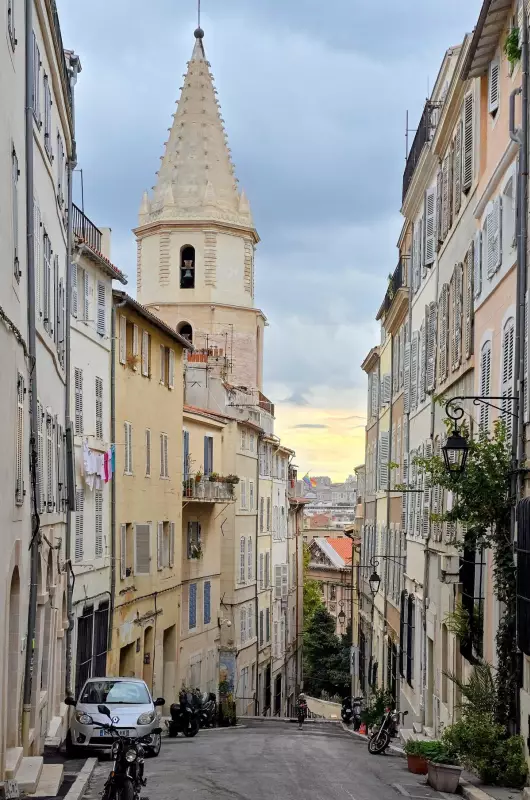
Stepping out from a hotel overlooking the Vieux Port, the journey north leads directly into the embrace of Le Panier. This is the very ground where, in the 6th century BCE, Greek Phocaeans sailed their swift penteconters across the Mediterranean to found Massalia, the settlement that would become modern-day Marseille.
The Lively Lanes of Le Panier
The terrain begins to climb, giving way to a captivating maze of steep, narrow streets and seemingly improbable staircases. The area pulses with creative energy, its pastel-hued facades and bare walls adorned with colourful graffiti, small paintings, and intricate mosaics. Every window ledge and doorstep, whether belonging to a home, boutique, or craft shop, boasts luxuriant pot plants, adding to the district's vibrant, lived-in charm.
Must-see landmarks like the Maison Diamantee, with its beautiful diamond-shaped stones, and the historic Hotel Dieu, now a luxury hotel, dot the area. Cafes are already bustling, their patrons spilling out onto sun-drenched squares and terraces to indulge in coffee and fresh pastries. It's easy to become distracted by the atmosphere, as the author and his wife D found, having to race to catch up with their local guides, Anne and Patrice.

A History Woven Like a Basket
Le Panier, meaning "The Basket," takes its name from a 17th-century inn, Le Logis du Panier. The name is fitting. Despite—or perhaps because of—its tumultuous cycles of war, migration, crime, regeneration, poverty, wealth, plague, and health, the district feels woven together from resilient, positive threads. It is a capacious and resilient basket, holding an abundant diversity of creative expression and cultural life.
A stop at a specialist bakery provides a taste of local tradition: a bag of freshly-baked navettes, the small, boat-shaped biscuits synonymous with Marseille and the wider Provence region. The first bite reveals a dry, crumbly texture with the faint, delightful taste of orange-blossom.
The Cultural Treasure of La Vieille Charite
The walk continues to La Vieille Charite, a 17th-century almshouse designed by Pierre Puget. This visit allowed for a proper exploration, not just of the exquisite Baroque chapel with its unique ovoid dome, but also of the superb museums housed within its three-storey arcaded galleries.
The first floor is occupied by the Museum of Mediterranean Archaeology, home to an exceptional collection. It comes as a genuine surprise to learn that its Egyptian holdings are rivalled in size and quality only by the Louvre's. One particularly haunting exhibit is a large sarcophagus, its leathery occupant clearly visible—a stark contrast to the animated Greco-Roman statuettes displayed in another room.
The second floor hosts the Museum of Art of Africa, Oceania and Amerindia, while the ground floor serves as a space for contemporary art exhibitions. The complex also includes a poetry centre, cinema, library, and an excellent cafe. The chapel's architecture is given a modern gloss by Laure Prouvost's 'Mere We Sea' installation, blending the historic with the contemporary.
After a restorative coffee, the departure from Le Panier leads past the imposing 19th-century Marseille Cathedral, La Major, an easy walk south-west of La Vieille Charite. Its comparison with the equally magnificent Notre-Dame de la Garde remains a story for another day. For travellers seeking an authentic slice of history, art, and Provencal life, a journey into the woven basket of Le Panier is an essential Marseille experience.