The overhead sun glows white through closed eyelids. Heat slowly warms still-damp skin as waves lap against the edge of the bay, gently rocking back and forth. Occasionally a boat rumbles past on the main strait, sending a wave into the sheltered cove and reminding that it is not a dream.
Exploring Stari Grad Bay
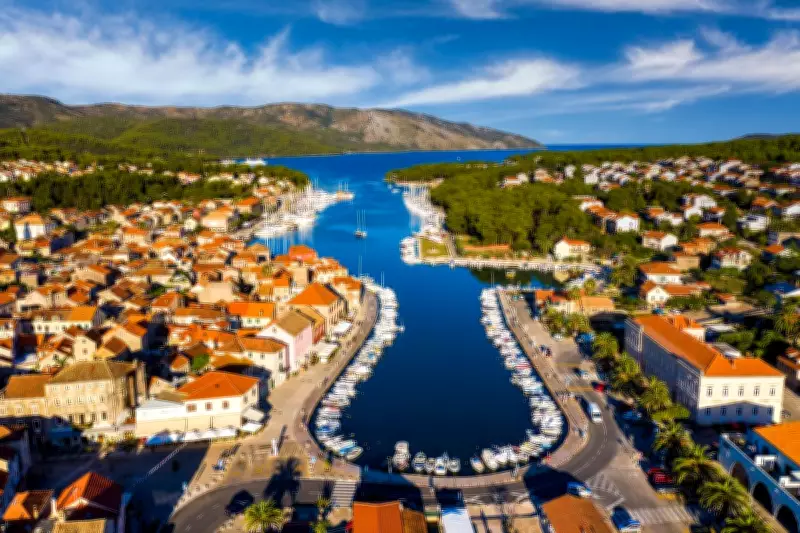
Our boat's bow tilts as Jordan pulls himself out of the shimmering water onto the deck. He raises the anchor, ready to move on to the next piece of paradise. We putter up Stari Grad Bay, a narrow strait that cuts into the island of Hvar, allowing the Adriatic Sea to meander in and meet the quiet coastal town of Stari Grad.
The island of Hvar is a diamond of the Dalmatian Coast, well-known for its main town of the same name that boasts historic architecture, lavender fields, vineyards, and Croatia's best nightclubs. However, for a slower pace and less crowded experience, Stari Grad is often overlooked. It is just as easy to reach Stari Grad as Hvar Town, with ferry services from Split running numerous times a day in peak season and taking only two hours. Buses are timed at the ferry port to meet arriving passengers and carry them into town.

History and Beauty
Once you set foot in Stari Grad, you are surrounded by beauty and history. Stari Grad translates to "Old Town" in English, and it lives up to its name. Established by the Greeks in about 384 BCE, it is Croatia's most ancient settlement, and the Stari Grad Plain surrounding the main town is a protected heritage site. Its original stone structures were built by ancient Greek settlers for agricultural purposes. Piles of rocks and stone walls built thousands of years ago are scattered across the island, each with its own story.
The main esplanade of the waterfront town is kept clean and updated, but the feeling of historic significance remains when walking the cobbled alleyways and gazing upon centuries of ancient architecture.
Boating and Swimming
The best way to spend a summer's day in Stari Grad is by renting a boat and heading out of town to explore the many small inlets along the main channel of Stari Grad Bay. You can drop anchor and swim in crystalline waters, watch super yachts and fishing boats come and go, and take a midday nap on the bow of the boat.
We find a hidden bayside restaurant on the suggestion of a local, requiring venturing to shore from a mooring point in the bay. Some people use kayaks or paddleboards to reach the restaurant, but we are not that prepared, so I swim ashore with one arm above my head clutching a bag of euros, boat keys, and a phone.
Evening in Town
After returning to town, it is an easy walk through the main esplanade. The sun softens in the sky, and the stone-walled buildings glow orange and gold. It is the long sunset season, and this hour stretches on, perfectly accompanying a dinner by the water. We watch local fishing crews return home for the day, delivering fresh catches directly to restaurants from the back of their boats.
A sushi chef has an outdoor kitchen set up next to the bay, acting as entertainment and convenient clean-up. He dissects a bluefin tuna while his guests watch in awe as their meal is prepared. He has specials every day that highlight different parts of the creature to minimise waste. Tonight it is the head of the bluefin, as big as the chef's torso.
We wander to revisit the restaurant we ate at last night. It is in a quieter part of town, set back from the water in a quaint street of mostly local homes. The family that runs the restaurant is welcoming, and the owner's dog comes to sit under my chair in the outdoor courtyard. "He likes you," the restaurant owner calls from across the street where he sits at a games table with a group of men, smoking and dealing cards. I eat the same meal as the night before, a prawn and squid ink pasta, because I know I'll never taste it again.
Assumption of Mary Procession
The town begins to shift into silence. Above us, shutters slam closed, and the jolly table of men pack up their games and disperse. The restaurant owner rolls his eyes and grumbles to himself as he shuffles upstairs to his house above the kitchen, calling his dog with him. "What's going on?" Jordan asks as we look around, suddenly realising we are the only people left outside on the quiet street.

Then we hear singing in the distance, moving closer as if on a breeze blowing across the bay. It takes a moment to distinguish the sounds, but if private school taught anything, it is how to recognise a liturgical song in any language. The throaty scent of incense begins to settle over us as the hymn grows closer, and we see the first of the procession round the corner.
Jordan and I share a panicked glance with forks halfway to our mouths. I catch the attention of the owner's daughter who stands up behind the now-closed windows of the restaurant, so we follow her lead as the procession passes by. Altar boys swing thuribles of incense, choristers young and old sing verse and chorus, deacons carry sacramentals, and finally, the priest flanked by cross bearers moves towards the church at the far edge of town before disappearing inside and plunging us back into silence.
Immediately the locals re-emerge, swinging open bedroom windows and restaurant doors. I see people pointing to the hill on the north side of the bay, where a cross glows white against the darkening sky. It is the Croatian holiday for the Assumption of Mary, and Stari Grad's culture is so rich that we became unintentionally immersed in a pilgrimage across the island.
The restaurant owner's group of friends duck their heads out of doorways to make sure the coast is clear, then reassemble their card table in the street. Cigarettes replace incense, and laughter becomes song as our shadows grow long across the cobblestones of the oldest town in Croatia.