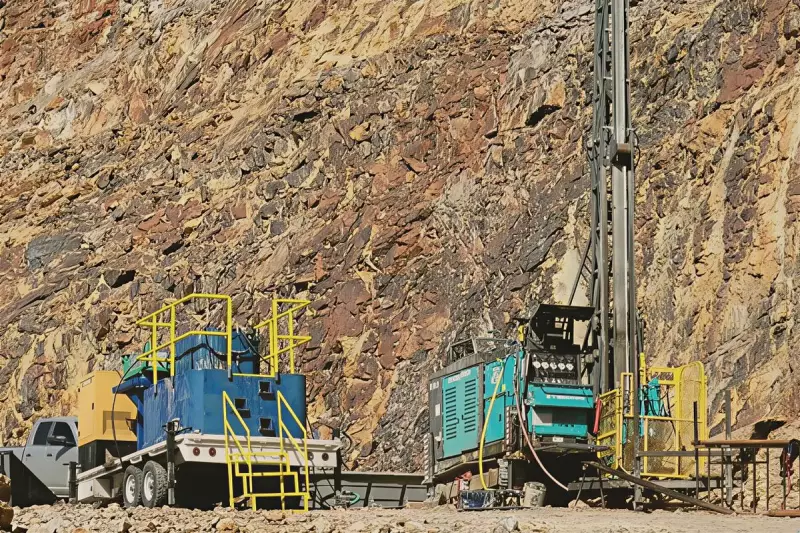
In a significant development for its flagship American asset, Dateline Resources has unveiled a fresh batch of impressive and wide gold intercepts from drilling conducted outside the currently mapped resource boundary at the Colosseum gold and rare earths project in California.
Standout Results Point to Major System
The company reported that results from six diamond drill holes and ten reverse circulation (RC) holes, focused around the existing South and North pits, have enhanced the understanding of mineral continuity. Crucially, several intercepts fell well outside the current mineral resource envelope.
The standout results were nothing short of epic. The lead intercept returned a massive 295.64 metres grading 1.04 grams per tonne gold (g/t) from surface. This was swiftly backed up by a second solid hit of 105.15 metres at 0.66g/t gold, also from surface. A third intercept measured a mammoth 300.21 metres running at 0.66g/t gold, strongly hinting at the vast scale of the mineralised system.

This drilling has confirmed that the primary host rock, a felsite breccia pipe, extends well beyond its previously known limits. The mineralisation aligns neatly with the company's magneto-telluric (MT) resistivity model, tracking directly into zones of high conductivity.
Open at Depth and Ready for Expansion
The RC drilling reached depths of up to 300 metres, nearing the practical limit of the rig. Notably, even at this depth, the drill bit remained within the breccia, strongly suggesting the mineralised system remains open at depth with further potential lurking below.
To test this theory, Dateline will now deploy diamond core drill rigs to replace the RC rigs. Diamond drilling can penetrate much deeper and retrieve continuous core samples, allowing for more detailed geological and grade analysis.
"These consistently strong intercepts at the North Pit and surrounding areas confirm that wide zones of gold mineralisation extend beyond our current mineral resource boundaries, highlighting significant expansion potential," said Dateline Resources managing director Stephen Baghdadi.
The company notes that beginning mining beneath the North Pit could substantially boost early-year production. The area is slated as the first mining focus under the development plan. As the pit is already partially developed, years of pre-stripping and access work are effectively done, allowing for faster, lower-cost ore access.
Strong Economics in a Prolific District
Recent drilling has confirmed thick, continuous mineralisation sitting directly below the pit floor. By scheduling these wide, near-surface zones early, the operation could deliver strong tonnages at consistent grades, supporting a smooth production ramp-up.
The ongoing drilling campaign supports Dateline's bankable feasibility study and aims to progressively upgrade the resource. The project already hosts a resource of 27.1 million tonnes at 1.26g/t gold for 1.1 million ounces, with over 67% in the measured and indicated categories.
Located in the prolific Walker Lane Trend in eastern San Bernardino County, less than 10km from the Mountain Pass rare earths mine, the district boasts a rich mining history dating to the 1848 gold rush. The project carries a post-tax net present value of US$550 million (A$850 million) and an internal rate of return above 60%, based on a conservative gold price of US$2900 per ounce. With gold currently trading well above US$4000/oz, these metrics could improve sharply.
Dateline has forecast total production of 635,000 ounces of gold over an initial 8.3-year mine life. With assays continuing to flow and deeper drilling planned, the latest results reinforce the open-at-depth potential and point toward a larger, higher-quality resource base as this modern Californian gold story continues to unfold.