Australian mineral explorer Taruga Minerals has unveiled a set of impressive new rock chip results from its recently optioned East Normanby gold project, located on Normanby Island in Papua New Guinea. The standout assay returned a high-grade result of 23.2 grams per tonne (g/t) gold, reinforcing the project's potential as a significant epithermal gold system.
High-Grade Results Confirm District-Scale Potential
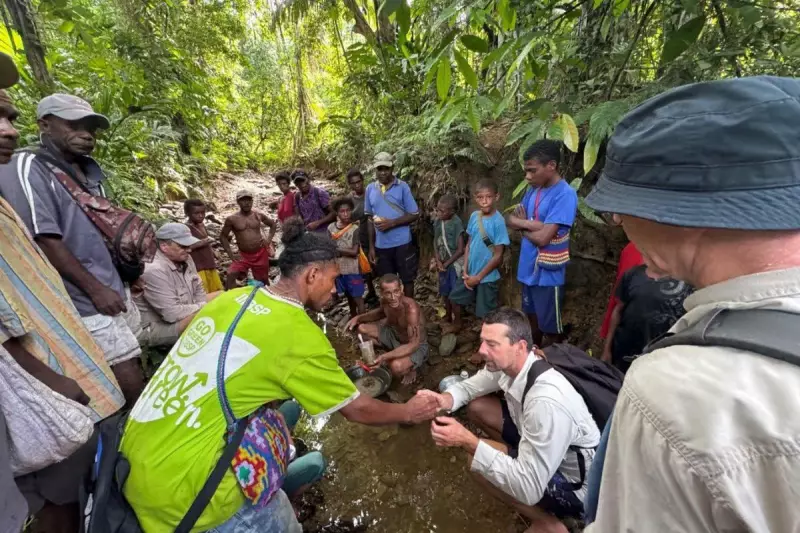
The assays were gathered during a due diligence field visit in November 2025, shortly before Taruga secured a 12-month option in December to acquire 100% of both the East Normanby project and the Kol Mountain copper-gold project on New Britain Island from a private Australian vendor. The results originate from the Weioko prospect, which forms part of an 8-kilometre-long gold trend stretching from the Wenasia prospect in the south to Sipupu in the north.
This trend sits within an even larger, 40-kilometre-long low-sulphidation epithermal gold district on eastern Normanby Island, centred on the prospective Milne Bay region. The recent rock chip sampling at Weioko yielded six significant samples, with grades ranging from the peak 23.2g/t down through 13.1g/t, 10g/t, 5.4g/t, and 1.2g/t gold.

According to the company, these findings confirm the presence of high-grade gold within epithermal quartz veins and disseminated mineralisation in silicified conglomerates. The mineralisation is hosted in Pliocene conglomerates that overlie basement metamorphic and volcanic rocks.
Historical Work and Future Exploration Focus
The Weioko deposit is not a new discovery, with historical work including trenching and 67 drill holes totalling 5,792 metres conducted between 1987 and 2009. This past work highlighted the area's potential, with one trench returning 108 metres at 2.4g/t gold, including a 28-metre section at 4.9g/t and a 4-metre interval grading a spectacular 21.9g/t gold. Another trench hit 68 metres at 5.9g/t gold.
Despite this previous activity, Taruga's technical director, David Chapman, noted that mineralisation at Weioko remains open at depth and along strike. "The interpreted deeper gold mineralisation at Weioko within the source metamorphics has not been intersected and is an immediate focus for future drilling," Chapman stated.
Encouraging signs were also found at the Wenasia prospect, roughly 4km south of Weioko, where a rock chip sample assayed 2.4g/t gold and 82g/t silver, pointing to underexplored silver potential. Artisanal gold panning activity in local streams further supports the prospect's merit.
Aggressive Program Planned for 2026
Buoyed by these strong initial results, Taruga Minerals is planning a comprehensive field program for the first quarter of 2026. The immediate focus will be on the Weioko district, starting with the re-plotting of historical trenches and drill holes using modern GPS technology. This will be followed by an expanded outcrop sampling and mapping campaign.
The company also intends to reprocess existing geophysical data, including induced polarisation (IP) and controlled-source audio-frequency magneto-tellurics (CSAMT) surveys. Additionally, Taruga is evaluating the use of new drone-borne magnetic surveys, satellite imagery, and infill geochemical sampling to generate priority drill targets.
With high-grade outcrops confirming an extensive, open gold system and modern exploration techniques set to define targets in the coming months, Taruga's swift entry into PNG's Milne Bay province appears strategically timed, especially amidst a strong gold price environment.