St George Mining has once again raised expectations at its flagship Araxá project in Brazil, with a fresh batch of outstanding diamond drilling results that promise to significantly expand its already substantial rare earths and niobium resource.
Exceptional Grades from Surface
The latest assays from the company's wholly-owned project in Minas Gerais have delivered thick, high-grade mineralisation starting right at the surface, extending into previously underexplored areas. These results have solidified the case for a substantial upgrade to the project's mineral resource estimate (MRE).
Highlights from the program are impressive, featuring intersections with up to 8.16% total rare earth oxides (TREO) and niobium oxide grades reaching 3.57%. This further cements Araxá's standing in the world's premier niobium-producing region. With another 28 diamond drill hole samples still at the laboratory, management anticipates more high-grade news to come.

Transforming the Scale of the Resource
One of the most notable intercepts returned a massive 128.6 metres grading 4.87% TREO and 0.85% niobium oxide from surface. The final 11.6 metres of this hole graded an even higher 5.61% TREO, confirming that the high-grade mineralisation remains open at depth.
This intercept now ranks as the second-thickest high-grade intersection ever drilled from surface at Araxá, substantially extending the known resource envelope. The company believes this demonstrates the clear potential for ongoing drilling to add both scale and grade to the project.
Other standout results include a 100.6-metre interval grading 4.25% TREO and 0.73% niobium oxide, which contained a high-grade zone of 19.6 metres at 8.16% TREO. A further 20-metre intercept from 39 metres depth recorded 5.94% TREO.
Significant Upside and Strategic Advantages
Critically, drilling has so far covered less than 10% of the project's total tenement area, leaving enormous potential for further growth. Most drill holes are ending in high-grade mineralisation, suggesting the system is open in multiple directions.
Diamond drilling continues 24/7 with three rigs operating as part of a 10,000-metre program scheduled for completion in the coming weeks. The current resource is modelled only to a depth of 100 metres, indicating clear potential for expansion both laterally and deeper.
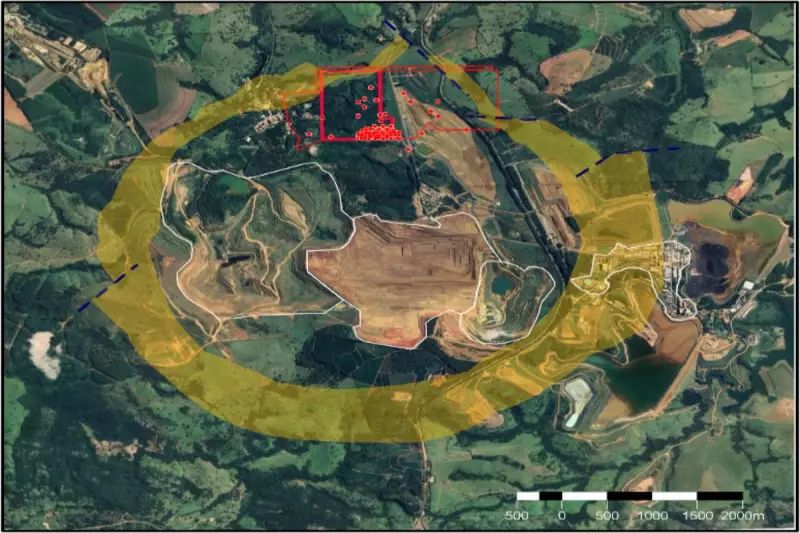
Araxá's location offers major strategic benefits, including established infrastructure and proximity to mining expertise. The project sits adjacent to the operations of CBMM, the world's largest niobium producer, which has successfully mined the metal for decades using conventional methods.
In a strategic move last October, St George partnered with the government-funded technology institute CEFET to develop a large-scale pilot plant. This "pilot-first" strategy is designed to de-risk the processing pathway and support future approvals.
Niobium is a critical mineral that, when added in small amounts to steel, dramatically increases strength while reducing weight. It is essential for infrastructure, automotive, aerospace, and advanced technology applications.
St George Mining executive chairman John Prineas said the consistency of the results was very impressive. "Together with the new mineralisation discovered beyond previously defined limits, the drilling is transforming the scale of the MRE and further positioning St George as one of the leaders in the rare earths and niobium sectors," he stated.
With its mineralisation rich in magnet rare earths, Araxá's existing 40.6-million-tonne resource is already South America's largest and highest-grade carbonatite-hosted rare earth deposit. As drilling continues to expand its scale and confidence, the project is rapidly emerging as a globally significant source for these critical materials.