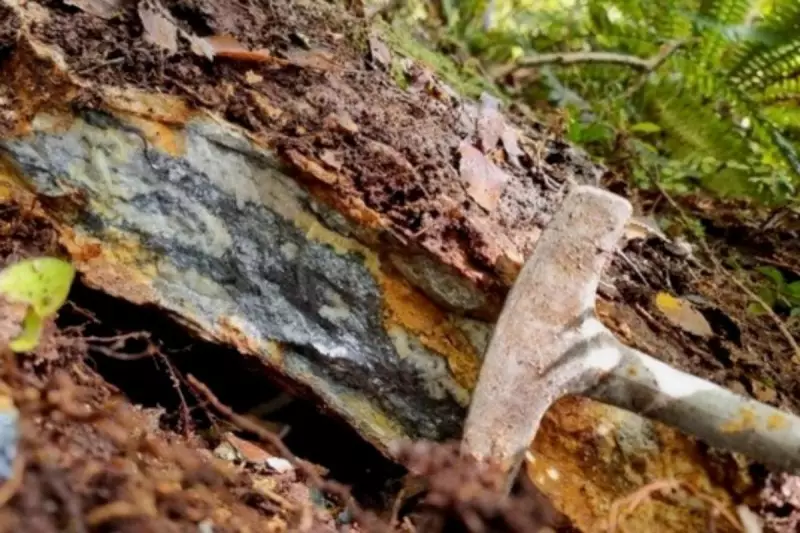
In a promising start to its exploration campaign, Siren Gold has delivered a suite of high-grade gold and antimony results from its initial fieldwork at the historic Queen Charlotte project on New Zealand's South Island. The early findings point to a robust mineralised system with significant potential, breathing new life into a historic mining district.
Encouraging Surface Results Confirm Mineralisation
Portable X-ray fluorescence (XRF) readings from surface channel and rock chip sampling have yielded encouraging numbers across several historic reef systems within the Marlborough District project area. While laboratory assays are still pending, the early data paints a picture of a substantial mineralised system.
At the Maria Reef, channel sampling returned 2.9 grams per tonne gold (g/t) and 1 per cent antimony over 6 metres. This included a standout 1-metre interval grading 2.2g/t gold and a hefty 12.4 per cent antimony. Similar high grades were recorded at the Skyline Reef, where samples delivered a 1.2-metre section running at 1.5g/t gold and 18.5 per cent antimony, along with a 1.6-metre hit going 1.6g/t gold and 9.7 per cent antimony.

Rock chip sampling further reinforced the project's potential, producing values of up to 4.6g/t gold and 26.2 per cent antimony across the three main prospects. These results highlight both the scale and consistency of mineralisation at surface.
A Historic Mining District with Modern Potential
The 118.7-square-kilometre Queen Charlotte project is located in the Marlborough region and hosts high-grade gold-antimony mineralisation within shear zones and quartz reef systems. The ground holds the historic Endeavour antimony mine, which was New Zealand's largest producer in the late 1800s, adding a layer of historical credibility to Siren's modern exploration.
The mineralisation is hosted within the Endeavour Shear Zone, a major regional structure mapped over more than 12 kilometres. The quartz reefs occur as sub-parallel, lenticular veins that generally strike north-northwest and dip steeply east. Stibnite, the primary antimony mineral, has commonly formed massive veins in the shallow portions of the old workings.
Three historic mining centres—Endeavour Inlet, Endeavour East, and Resolution Bay—lie along the shear zone. Endeavour Inlet alone was mined over a 1,200-metre strike length and 400-metre vertical extent, producing more than 3000 tonnes of stibnite ore between 1870 and 1890.
Path Forward: From Fieldwork to Drilling
Siren Gold's chief executive officer, Zayn Peyman, stated the company has confirmed historic small-scale mine workings along a 1500-metre strike and down to 400 metres depth. "Assay results from our latest channel and rock chip sampling have been very encouraging, and we've uncovered additional outcrops and workings in the field," Peyman said.
The company's next steps will focus on regional soil geochemistry and detailed mapping over the full five-kilometre gap between the historic mines. This work is designed to refine drill targets ahead of a maiden drilling program, which is slated for later this year.
In a market hungry for both gold and critical minerals like antimony, the Queen Charlotte project is shaping up as far more than a history lesson. With standout surface grades, proven metallurgy from historic operations, and a large shear system in a stable, mining-friendly jurisdiction, Siren Gold appears well-positioned to transform a forgotten antimony camp into a modern, drill-driven growth story.