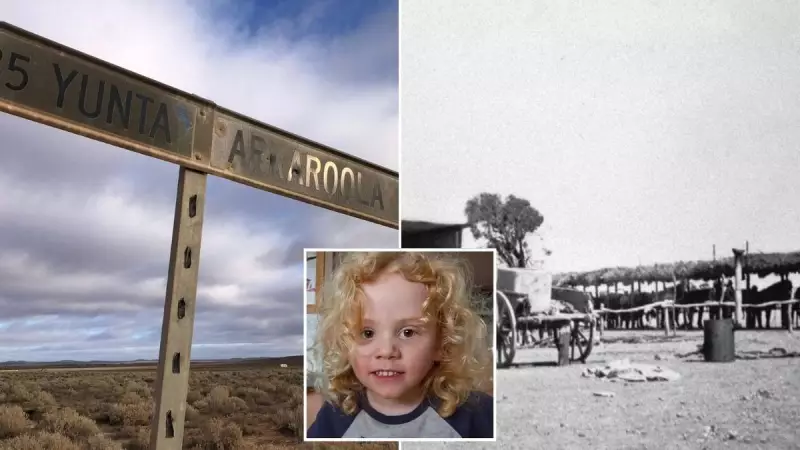
More than two months after four-year-old August 'Gus' Lamont disappeared from his family's remote South Australian property, police have made a startling discovery that underscores the hidden perils of the outback landscape. The search for the little boy has led authorities to six previously unknown mine shafts surrounding the homestead, uncovered through advanced aerial mapping technology.
Hidden Dangers Revealed by Modern Technology
The most recent search operation last week took a dramatic turn when police, utilising data from recent aerial surveys, realised there were six undocumented mine shafts near the Lamont property that they had no prior knowledge of. This discovery was made possible by LiDAR (Light Detection and Ranging) technology, a remote-sensing method that uses laser pulses to create highly detailed three-dimensional maps of the environment.
This breakthrough has cast a harsh spotlight on the forgotten legacy of South Australia's gold rush era. The region around Yunta, where Gus went missing, was once dotted with small, short-lived mining operations dating back to the late 19th and early 20th centuries. When prospectors moved on, they left behind countless shafts that were never properly documented or sealed, gradually vanishing from official records but remaining as deep, unfenced hazards in the remote scrub.

Relics of a Forgotten Gold Rush
The newly discovered shafts are stark relics of a frantic period in South Australian history. In 1886, more than 5,000 miners rushed to the Teetulpa goldfield, northeast of Yunta, extracting a remarkable 3,132 kilograms of gold in just three years. Shafts were dug hastily and abandoned when the rush subsided, leaving a dangerous legacy.
This legacy has proven deadly over the years. South Australia's abandoned mines have claimed several lives, including a 55-year-old man from Pooraka who died after falling into a shaft in Coober Pedy in 2006. That same year, the body of a 45-year-old local woman was recovered from a shaft in the Dead Man's Gully opal field. As recently as 2024, a man narrowly escaped with his life after falling 30 metres down an opal mine shaft near Coober Pedy.
The historical context is rich. At Waukaringa, just north of Yunta, gold was mined from 1873 to 1969, with 1,427 kilograms extracted. Yunta itself was founded in 1887 as a thoroughfare for miners heading to Teetulpa and Waukaringa, later becoming a crucial railway hub linking Adelaide to Broken Hill. The towns that once boomed have largely vanished, leaving behind ghostly remnants like towering stone chimneys and the ruins of hotels, shops, and schools.
A Community's Heartbreak and a Frustrating Search
For the small, tight-knit community of Yunta, Gus Lamont's disappearance has been devastating. Family friend Bill Harbison told 7NEWS the family remains shattered, stating, "We miss him more than words can express." Despite the exhaustive efforts, the latest search of the newly found mine shafts yielded no further clues.
The scale of the search has been immense. Authorities have drained a dam containing 3.2 million litres of water and combed through 470 square kilometres of rugged terrain in scorching heat. So far, searchers have found only a single footprint approximately 500 metres from the homestead. Police Commissioner Grant Stevens acknowledged the profound difficulty, noting there are "lots of places a small child might find themselves which are hard to identify."
Gus was last seen on September 27, playing outside the homestead on the family's 6,000-hectare Oak Park station, located 43 kilometres south of Yunta. His grandmother was inside caring for his younger brother, while his mother and other grandparent were tending sheep. Authorities stress there is no evidence of foul play but have not ruled it out. For the Lamont family and the Yunta community, the agonising wait for answers continues, set against a landscape that still guards the secrets of its turbulent past.