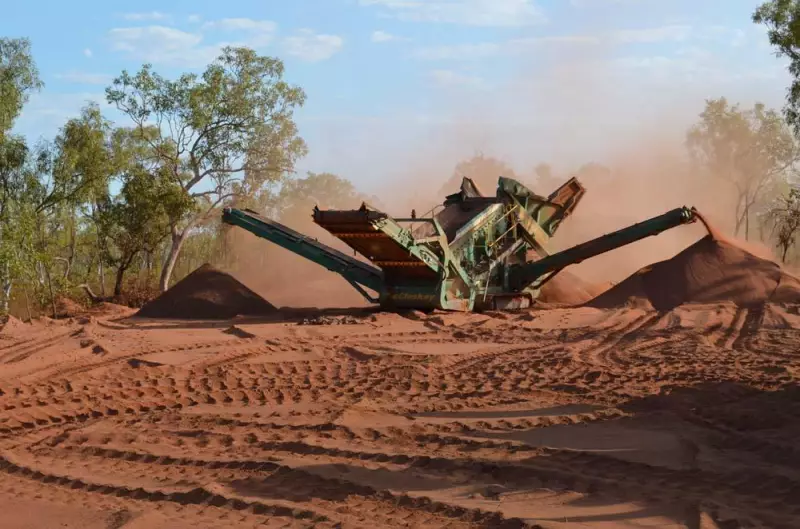
The Federal Government's Northern Australia Investment Facility (NAIF) has thrown a financial lifeline to the struggling Thunderbird mineral sands mine in the Kimberley, agreeing to defer repayments on a massive $160 million loan. This move comes as the government-backed financier faces the prospect of another major investment failure.
Mine Owners in Precarious Position
Sheffield Resources, which owns the Thunderbird mine in a 50/50 joint venture with China's Yansteel via Kimberley Mineral Sands (KMS), revealed the repayment deferral in an ASX statement on Friday, 19 December 2025. The company's shares plummeted to an all-time low of 6.8 cents that morning, reflecting severe market pressure.
The West Perth-based miner is battling a perfect storm of a weak global mineral sands market and lower-than-expected mining and processing rates at the Thunderbird operation. Sheffield stated that collaborative discussions with lenders NAIF and New York's Orion Resource Partners are ongoing but warned there is no guarantee of a successful outcome or that KMS will secure necessary funds from shareholders to meet its working capital needs.

Mounting Debt and a Controversial History
By the close of the 2025 financial year, the financial situation was dire. Kimberley Mineral Sands held just $15 million in cash while owing approximately $157 million to NAIF and about $150 million to Orion Resource Partners. NAIF's original $160 million loan was issued in October 2022.
The potential collapse of KMS would add to a growing list of troubled investments for NAIF. The facility was originally established to fund infrastructure in remote parts of Western Australia, Queensland, and the Northern Territory, particularly in Indigenous communities. A shortage of such projects led it to expand into riskier mining ventures, with mixed results.
A Pattern of Failed Investments
This year has been particularly bruising for the taxpayer-funded financier. In February, mineral sands miner Strandline Resources collapsed, leaving NAIF with losses of $154 million. Prior to that, in August 2023, Australia's first potash producer, Kalium Lakes, went bankrupt, resulting in a $74 million hit for NAIF. The agency had also pledged $140 million to Australia Potash, which suffered a similar fate, though that loan did not finalise before the company's failure.
The loan to the Thunderbird venture has been arguably the most controversial, drawing scrutiny over strategic implications. Yansteel's interest in the mine centres on zirconium, a critical mineral extracted at Thunderbird. Zirconium is used for cladding nuclear fuel rods and in alloys for hypersonic missiles. An ABC Four Corners investigation in November found evidence that China was re-exporting some processed zirconium from the mine to Russia, raising further geopolitical concerns.
The future of the Thunderbird mine and the NAIF's investment now hangs in the balance, as stakeholders negotiate against the clock to salvage the operation.