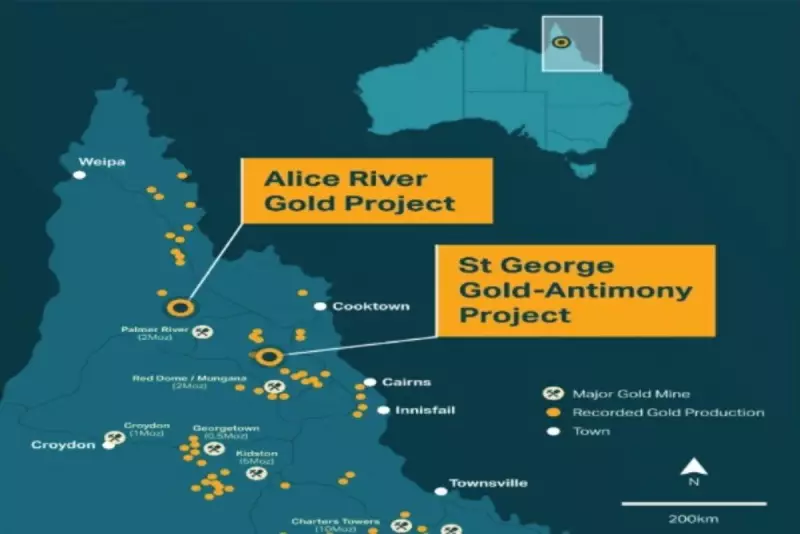
In a major boost for Queensland's resources sector, Pacgold Limited has identified a potentially huge gold-antimony system stretching over 14 kilometres at its St George project in the state's north.
Significant Soil Survey Results
The company's first-pass soil geochemical program has outlined an extensive zone of anomalism, revealing two powerful trends for gold and antimony. Each trend runs for more than 7 kilometres along a key structural corridor, encompassing the Fence and Ridgeline prospects. The most robust soil responses extend for up to 1.5 kilometres and remain open along strike, indicating substantial potential for further discovery.
Adding considerable weight to the findings, pathfinder elements arsenic and mercury also returned anomalous readings along the same structures. This geochemical signature is a classic indicator of gold-antimony mineralising systems.

Remarkably, these newly defined anomalies have never been tested by modern drilling techniques. This highlights the project's underexplored status, despite its location within one of Australia's most prospective mineral provinces. Assay results from the soil program are pending and expected early in 2025.
High-Grade Rock Chip Samples
Complementing the soil survey, rock chip sampling has delivered spectacular, high-grade results. At the Fence and Ridgeline prospects, one sample assayed an extraordinary 52.7 per cent antimony with 2.93 grams per tonne (g/t) gold.
Additional samples returned equally impressive grades, including 9.35 per cent antimony with 10.2g/t gold and 0.49 per cent antimony with 8.42g/t gold. Pacgold managing director Matthew Boyce noted that these outstanding soil anomalies were found in tenements located 5 kilometres south of the historical St George mine, demonstrating the extensive scale of the mineralised system.
Drilling Campaign and Project Context
Pacgold plans to refine its targets and launch a pivotal drilling campaign in the second quarter of 2026, following the North Queensland wet season. Multiple targets are expected to be tested.
The St George project is situated about 70 kilometres west of Mt Carbine and covers a substantial 905 square kilometres within the emerging Hodgkinson antimony province. The tenement package comprises seven licences, with Pacgold earning up to a 100 per cent interest under a farm-in and joint venture agreement with Hardrock Mineral Exploration.
Since entering the project in August 2024, Pacgold has moved swiftly, collecting more than 2,000 soil samples. The company believes the tenements host some of the most antimony-rich and well-developed veins in the Hodgkinson Province, a region fast becoming a premier address for gold-antimony exploration in Australia.
Geologically, the mineralisation shows strong similarities to nearby deposits like Tregoora and Northcote, which produced over 550,000 ounces of gold in the 1980s. The broader Hodgkinson Province has a rich history, with the Palmer River and Hodgkinson goldfields yielding nearly 1.6 million ounces in the late 1800s and early 1900s.
Pacgold's growing exploration footprint at St George complements its nearby Alice River project, which already hosts a global gold resource of 854,000 ounces. The company has also bolstered its development profile with the acquisition of the fully permitted White Dam gold operation in South Australia.
With drilling on the horizon and surface results already revealing eye-catching grades, the focus now shifts to what lies beneath the extensive structures at St George.