Gateway Mining Unveils Major Gold Exploration Corridor in WA's Gascoyne Region
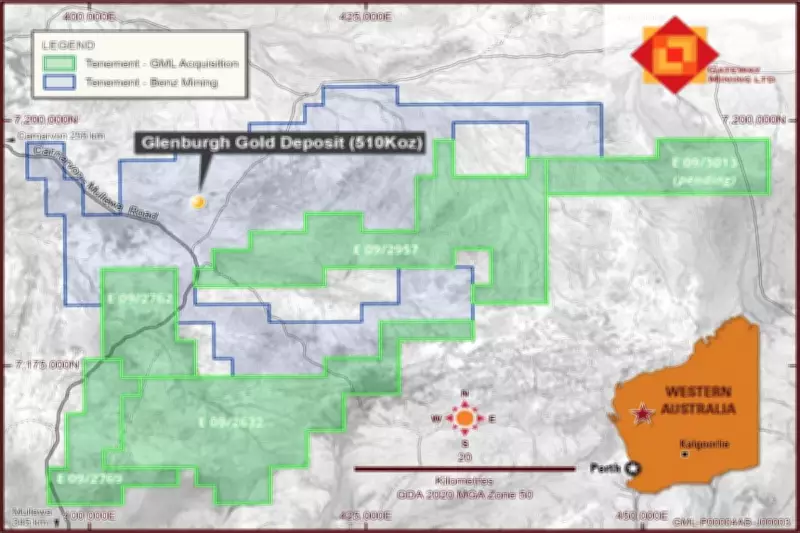
Gateway Mining has announced the discovery of a significant new gold exploration corridor, spanning 15 kilometres across its Glenburgh South project in Western Australia's Gascoyne region. This development places the Perth-based explorer in close proximity to a proven gold system, specifically adjacent to Benz Mining's impressive 500,000-ounce Glenburgh gold deposit.
Geophysical Insights Reveal Promising Structural Footprint
Recent high-resolution airborne magnetic surveys have mapped a continuous structural corridor on Gateway's ground, mirroring the stratigraphic position of the gold-hosting trend at Benz's deposit. The latter already boasts a resource of 16.3 million tonnes at 1.0 grams per tonne of gold. The magnetic data indicate a complex structural setting with multiple phases of folding and secondary structures, which are typically favourable traps for gold mineralisation.
Andrew Bray, executive chairman of Gateway Mining, emphasised the significance of this find: "The completion of this high-resolution magnetic survey at Glenburgh South has confirmed what is emerging as a very promising extension of the prospective stratigraphy that hosts Benz Mining's highly impressive Glenburgh Gold Deposit."

Hyperspectral Analysis and Historical Context
Adding further weight to the target, hyperspectral analysis conducted by consultancy firm EarthDaily has identified elongate kaolinite-dominated alteration anomalies along the same 15km corridor. These spectral signatures closely match alteration patterns observed above Benz's Glenburgh deposits, suggesting similar mineralising processes may be at play.
Previous geological mapping and geochemical sampling in the area have already confirmed gold anomalism near the main structural trend, though much of the corridor remains largely untested. The project is situated within the ancient Gascoyne Complex at the core of WA's Capricorn Orogen, formed from the collision of the Pilbara and Yilgarn cratons millions of years ago. Gold occurs within sheared and silica-rich gneissic units, where high-grade metamorphism has recrystallised the metal, potentially improving gravity recovery during processing.
Exploration Potential and Future Plans
Gateway Mining believes the area could host multiple exploration targets beyond the primary corridor, based on magnetic imagery revealing secondary structural trends and a major fold hinge. Such features are often prime locations for gold deposition in structurally complex terrains. The project shares strong similarities with the world-class Tropicana gold discovery, a 5.4-million-ounce deposit found in Archaean gneissic rocks.
Despite its favourable geology, the region inland from the Carnarvon–Gascoyne area remains relatively underexplored compared to WA's more established gold provinces. Historic exploration by Normandy Mining in the early 1990s confirmed gold potential through regional stream sediment sampling, but the area has seen limited activity since.
Gateway plans to immediately follow up on this discovery with project-wide soil sampling to trace mineralised trends, supported by detailed geological mapping and rock-chip sampling. If upcoming soil sampling yields positive results along the trend, the company could quickly advance from geophysical theory to drill-ready targets.
With a 15-kilometre structural corridor now mapped and geological clues aligning favourably, Gateway's Glenburgh South project is emerging as one of the more intriguing new exploration plays in WA's underexplored Gascoyne region, bolstered by its proximity to a proven gold system and Tropicana-style geological setting.