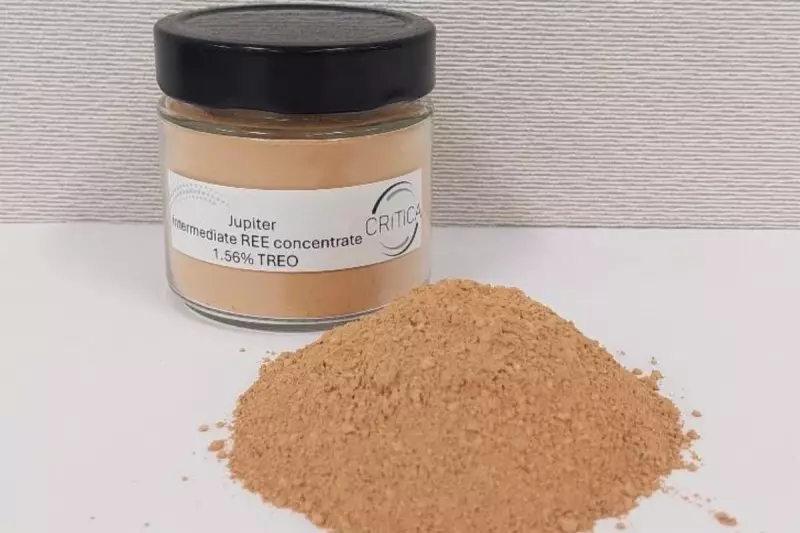
In a significant boost for Western-aligned critical minerals supply, Australian explorer Critica Limited has announced the production of a second high-grade mixed rare earths product from its Jupiter project in Western Australia's Mid West region.
Consistent High-Grade Results Validate Project Scale
The latest batch, sourced from a completely different area of the clay-hosted resource than the first samples, achieved an impressive 86% total rare earths oxides (TREO) at a 68% recovery rate after ore upgrading. This result aligns almost perfectly with the standout figures from October, which delivered 83.6% TREO at the same recovery rate.
Critica's Chief Executive Officer, Jacob Deysel, stated that producing a second high-grade product from a separate domain within Jupiter represents a major validation step. "We are seeing exactly what a scalable project should demonstrate—consistent, repeatable upgrade of the four high-value Magnet Rare Earths and Yttrium from the global resource, through beneficiation, and into final product," Deysel said.

Metallurgical tests confirmed that the beneficiated Jupiter concentrate can be processed using straightforward and scalable hydrometallurgical methods to yield a clean, high-purity oxide product.
Strategic Magnet Metals and Impressive Upgrading
The Jupiter deposit, part of the broader Brothers project located 50km west of Mt Magnet, holds Australia's largest and highest-grade clay-hosted magnet rare earths resource. It boasts a massive 640 million tonnes grading 490 parts per million (ppm) of the crucial magnet rare earth oxides.
The project is notably rich in the high-value oxides of neodymium, praseodymium, dysprosium, and terbium. These elements are essential for manufacturing permanent magnets used in electric vehicles, renewable energy systems, defence technology, and energy storage devices.
A remarkable aspect of the latest results is the dramatic upgrade of specific elements. The concentration of key magnet rare earths soared more than 40,000 to 60,000 per cent above their in-situ grades. Furthermore, yttrium—a metal under tight control by China—exploded by over 30,000 per cent, jumping from just 74 ppm in the resource to more than 24,000 ppm in the product.
Pathway to Production and Strategic Advantages
Critica's technical development is gaining momentum with substantial backing. A 3,000-kilogram beneficiation pilot plant in Hanoi is being commissioned with support from Vietnam's Centre of Science and Technology of Minerals and Environment (GAVQ). This facility will help finalise product specifications for magnet rare earths, yttrium, gallium, and other by-products, feeding directly into a scoping study scheduled for the first half of 2026.
Further metallurgical work is being conducted by leading Australian institutions. The government-backed Australian Nuclear Science and Technology Organisation (ANSTO) is performing extraction, leaching, and recovery tests on the upgraded concentrates, leveraging decades of expertise in rare earth chemistry and uranium-thorium management. Perth-based hydrometallurgical specialist Minutech-AMML is also involved, testing acid leaching, impurity removal, and precipitation processes.
The project benefits from several key advantages critical to its future economics:
- An ultra-low uranium and thorium content, simplifying processing and waste management.
- Location in a Tier-1 mining jurisdiction near established infrastructure.
- Proximity to rare earths processing hubs like Lynas Corporation's Kalgoorlie operations, as well as ports, rail, and energy networks.
With two high-grade products now confirmed from separate parts of the orebody, a pilot plant moving into operation, and multiple laboratories corroborating consistent results, Critica is advancing a technically robust rare earths solution. This progress comes at a pivotal time, with global markets urgently seeking diversified supply chains beyond China, which still controls over 90% of the downstream rare earths supply.

Financially, the company is well-positioned to accelerate, having recently secured $8 million from a capital raise. This injection will push its total war chest to nearly $12 million once an R&D rebate is received, providing the firepower to drive the Jupiter project toward its next major milestones.