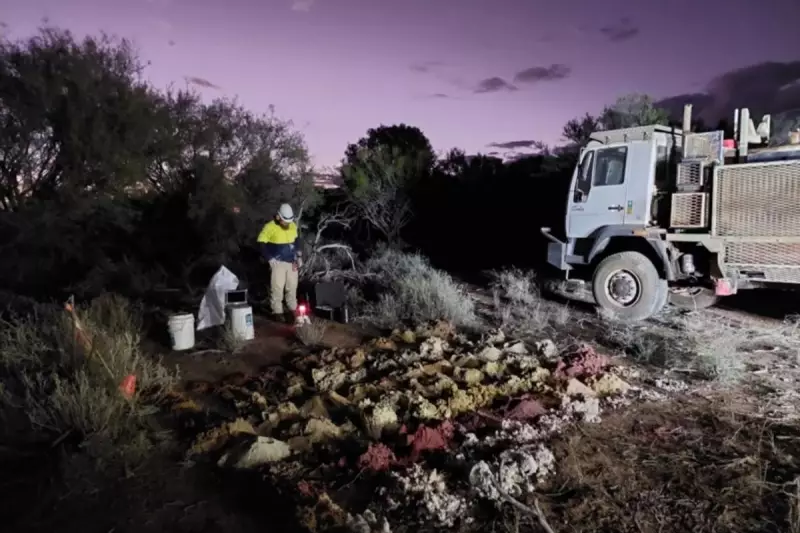
In a significant move for Australia's critical minerals sector, Perth-based Critica Limited has formally commenced a scoping study at its flagship Jupiter rare earths project. The project is located in the well-serviced Yalgoo region of Western Australia's mid-west.
Major Technical Team Assembled for Key Study
The scoping study will be spearheaded by the global engineering firm Sedgman, which will lead the work to transform the project's potential into a credible development blueprint. They will be supported by mining specialists Snowden Optiro and resource experts SRK Consulting, forming a heavyweight technical consortium.
Critica's Chief Executive Officer, Jacob Deysel, stated that appointing Sedgman marks a pivotal shift for the company from technical validation towards defining a clear development pathway. Sedgman's Managing Director, Grant Fraser, echoed this sentiment, highlighting Jupiter's compelling combination of scale and favourable metallurgy.

Jupiter's Scale and Simplicity a Key Advantage
The Jupiter deposit is billed as Australia's largest clay-hosted rare earths resource, containing a massive 1.8 billion tonnes at an average grade of 1700 parts per million (ppm) total rare earth oxides (TREO). Critically, the resource is enriched with the high-value magnet rare earths needed for permanent magnets: neodymium, praseodymium, dysprosium, and terbium.
A notable bonus is the presence of 39 ppm gallium, a metal used in advanced electronics. Furthermore, the deposit has low levels of problematic elements like uranium and thorium, which is expected to simplify future environmental permitting and reduce processing complexity.
The flat-lying, near-surface nature of the clay-hosted mineralisation is acknowledged for its simpler metallurgy compared to hard-rock deposits. This underpins Critica's "beneficiate-first" strategy, aiming to upgrade the ore by six to ten times early in the process before any downstream refining begins, potentially lowering capital intensity.
Parallel Programs Aim to De-Risk Development
Alongside the headline scoping study, Critica is advancing several parallel technical programs. Metallurgical test work is ongoing with specialist labs, including ANSTO, to refine the mixed rare earth product pathway. A pilot-scale beneficiation program with Brazil's GAVAQ is assessing a closed-circuit operation to fine-tune the process flowsheet.
Results have shown that the beneficiated Jupiter concentrate can be leached using less expensive and scalable hydrometallurgical methods to produce a high-purity oxide product. The company is also planning a drilling campaign intended to increase the resource tonnage and grade and upgrade the resource from the inferred to the indicated category.
On the commercial front, Critica is progressing engagement with potential off-take partners and downstream technology partners. The company is also conducting trials for selective gallium precipitation and screening options for recovering scandium and germanium.
Timeline and Macro Backdrop
Critica is targeting completion of the scoping study in the first half of 2026, subject to work programs. If the economics are positive, the company aims to deliver a pre-feasibility study in the second half of 2026, followed by a definitive feasibility study in 2027 and a potential final investment decision thereafter.
This development unfolds against a powerful macro backdrop where demand for magnet rare earths is accelerating, driven by electric vehicles, renewable energy, and defence applications. With global efforts to diversify supply chains away from China, projects like Jupiter that offer scale, simplicity, and capital discipline are attracting significant attention.
For Critica, the Jupiter scoping study represents more than just an economic assessment; it is the crucial bridge between discovery and development, and a key step in the company's broader ambition to become a mine-to-magnet supplier in the global critical minerals race.