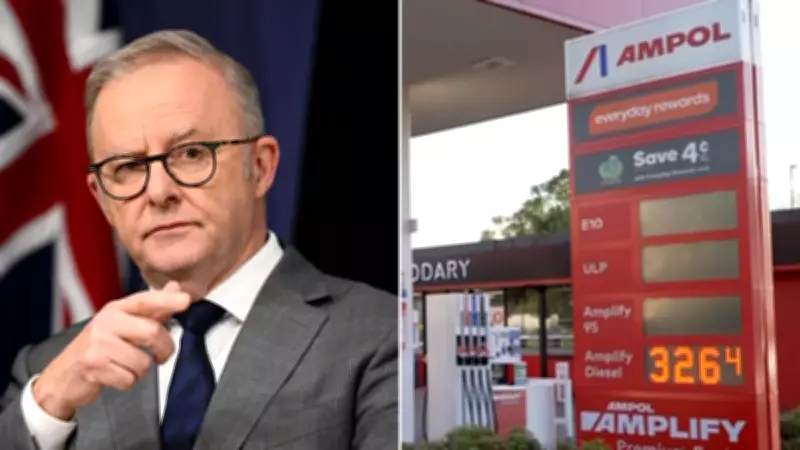
Prime Minister Anthony Albanese's $10 billion fuel security plan has been welcomed as a major step forward, but experts warn it will not fully solve Australia's fuel security vulnerabilities.
The package, set to be formally unveiled in next week's federal budget, aims to lift Australia's fuel reserves to 50 days, boost fertiliser security, and establish a permanent government-owned fuel reserve of about one billion litres.
Supply chain expert David Leaney said the announcement marked the most significant investment in Australia's fuel resilience in years, particularly after growing concerns sparked by instability in the Middle East and threats to global shipping routes.

"This is probably the biggest step that Australia's had in fuel security for a very long time," Leaney said.
But Leaney warned the package would not fully solve Australia's long-running fuel vulnerabilities.
"We're still not meeting our 90-day obligations under the IEA (International Energy Agency), and we still haven't replicated all of that infrastructure right across Australia and the regional areas," he said.
Australia remains heavily reliant on imported fuel, despite repeated warnings in recent years about the risks posed by geopolitical conflict and disruptions to major shipping lanes, including the Strait of Hormuz.
Under the government's plan, $3.2 billion will go towards building a government-owned reserve of about one billion litres to strengthen diesel and aviation fuel supplies. Another $7.5 billion will establish a fuel and fertiliser security facility designed to increase domestic storage and supply capacity. The package will also progressively increase minimum stockholding obligations, adding an extra 10 days of fuel holdings.
The announcement comes as Queensland Premier David Crisafulli backs a proposed $11 billion domestic drilling and refining project in Gladstone, which could produce about 210,000 barrels per day, equivalent to roughly one billion litres a month.
When asked whether Australia would be better off investing in domestic production rather than storage, Leaney said both approaches were essential.
"These are really important complementary investments," he said. "There's no point in just having storage if you're not getting supply, and there's certainly no point in just having supply if you don't have the storage."
Leaney also stressed Australia would continue to rely on imported fuel regardless of how much domestic storage capacity was built.
"We will always be dependent on fuel imports to a majority extent, even if we extended 90 days' worth of supply in Australia, that still requires import," he said.
He said maintaining strong relationships with regional partners would remain critical to Australia's fuel security strategy, pointing to strengthened ties with Singapore, South Korea, Brunei, and Malaysia in recent months.
The fuel package follows a series of emergency measures introduced by the government in response to the ongoing conflict in the Middle East, including relaxing fuel standards to help stabilise supply and prices.