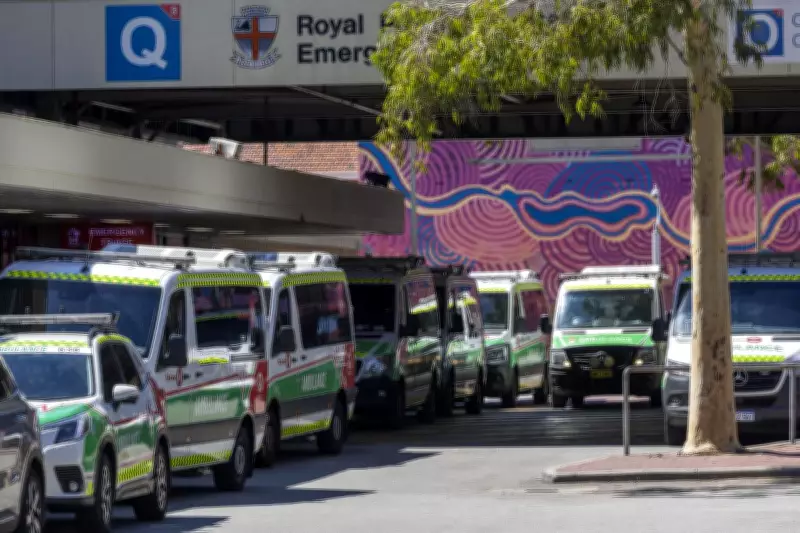
Western Australia has recorded its worst April for hospital ramping in four years, with ambulances delayed for more than 2,100 hours as the government struggles to secure beds ahead of winter.
New data released on Friday reveals that paramedics were stuck outside emergency departments for a total of 2,178 hours in April, marking a 15 per cent increase compared to the same month last year.
The figures have sparked fresh concerns about the state's health system, with the Australian Medical Association (AMA) describing the situation as a "horror start" ahead of the winter season.

Ramping crisis deepens
Ramping occurs when ambulance crews are unable to transfer patients to hospital staff due to a lack of available beds, forcing paramedics to wait with their patients outside emergency departments.
In April, the average ramping time per incident was 42 minutes, up from 38 minutes in March. More than 300 incidents exceeded two hours, with some patients waiting up to six hours for a bed.
The worst-affected hospitals were Royal Perth Hospital, Sir Charles Gairdner Hospital, and Fiona Stanley Hospital, which collectively accounted for over 60 per cent of all ramping hours.
Government response
Health Minister Amber-Jade Sanderson acknowledged the pressure on the system and said the government was taking urgent action to free up beds.
"We are investing in additional bed capacity, expanding virtual care services, and working with private hospitals to take on more public patients," Ms Sanderson said.
The government has announced a $50 million package to open 100 new beds across metropolitan hospitals, with 50 beds expected to be operational by June. However, health experts warn that more beds alone will not solve the underlying issues.
AMA warns of winter surge
AMA WA President Dr Michael Page said the April figures were a "red flag" for the health system.
"We are heading into winter with the system already under severe strain. The ramping data shows that we are not prepared for the expected surge in respiratory illnesses and flu cases," Dr Page said.
He called for a comprehensive plan to address workforce shortages, patient flow, and hospital capacity.
"Beds are only part of the solution. We need more nurses, more doctors, and better coordination between hospitals and aged care facilities to free up beds," he said.
The AMA has also renewed its calls for the government to implement a dedicated winter preparedness strategy, including funding for additional staff and expanded telehealth services.
Opposition criticism
Shadow Health Minister Libby Mettam accused the government of failing to act on repeated warnings.
"This is a crisis of the government's own making. They have had years to fix the health system, but instead we see record ramping and patients waiting hours for care," Ms Mettam said.
She called for an independent inquiry into hospital performance and ramping.
Winter outlook
Health officials are bracing for a challenging winter, with modelling predicting a 20 per cent increase in emergency department presentations compared to last year.
The Department of Health has activated its winter surge plan, which includes opening additional beds, extending hours for GP clinics, and promoting flu vaccinations.
However, experts warn that without significant investment in workforce and infrastructure, the system will continue to struggle.
"We need a long-term plan, not just short-term fixes," Dr Page said. "The community deserves a health system that can provide timely care, regardless of the season."