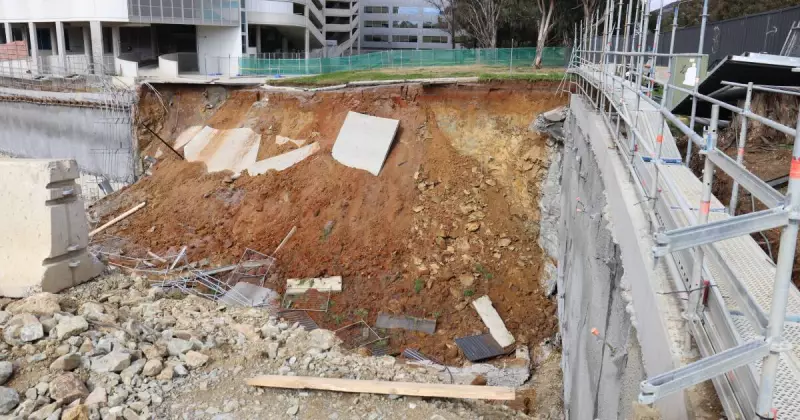
A Canberra engineering company has been slapped with a massive $750,000 penalty after a court found it failed in its safety duties, with a poorly designed shoring wall collapse posing a deadly risk to workers and the public.
A Catastrophic Failure in Phillip
On Monday, December 8, Magistrate Ian Temby imposed the hefty fine on the Structural Design and Construction Company (SDCC). The firm, now in external administration and facing deregistration, was the principal contractor for Geocon's WOVA residential and commercial project in Phillip.
The incident occurred on August 6, 2022, at approximately 2:30pm. The shoring wall, designed by SDCC to support an excavation roughly 13 metres deep for three basement levels, gave way in a matter of seconds.

Debris from the collapse travelled about 15 metres. Alarmingly, just five minutes later, a section of the driveway from a neighbouring multi-storey car park also crumbled into the massive hole.
'A Very Real Possibility' of Multiple Deaths
In his sentencing remarks, Magistrate Temby labelled the offence as "a very serious example" of its kind. He stated the likelihood of a collapse "was obvious and significant" and that appropriate, safer design measures were "reasonably practical" and part of the company's paid remit.
The magistrate's findings were stark: "multiple fatalities were a very real possibility." He outlined two clear scenarios: the risk of death to any worker within 15 metres of the wall face, and the risk to occupants of any vehicle that could have fallen into the excavation.
By sheer chance, the collapse happened on a Saturday when no construction staff were on site. However, the adjacent public car park was open and in use. Video evidence showed multiple vehicles in the area that could have been caught in the disaster.
One car drove over the section of the driveway that later collapsed less than a minute before the wall failed.
Contributing Factors and Final Ruling
While geotechnical experts could not pinpoint a single definitive cause, the court identified several likely contributors. These included rock fractures at the failure site and rainfall in the period leading up to the collapse.
Critically, Magistrate Temby noted that the shoring system design should have accounted for variables like groundwater and soil moisture, which it evidently did not.
The fine marks the conclusion of a case that underscores the grave consequences of cutting corners in construction and engineering design, especially in dense urban environments like Canberra's Phillip precinct.