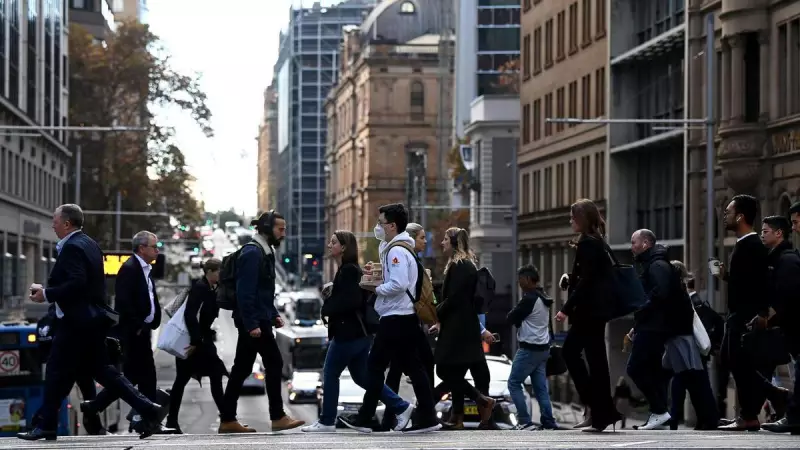
Australia's economic engine has revved up to its highest speed in two years, powered by a significant jump in government expenditure. New data reveals the nation's output expanded more robustly than many anticipated, setting the stage for continued scrutiny from the central bank.
Quarterly Growth Beats RBA Forecasts
According to the Australian Bureau of Statistics, the country's gross domestic product (GDP) increased by 0.4 per cent during the September quarter. This result lifted the annual growth rate to 2.1 per cent, marking the strongest yearly expansion since March 2023. The figures, released on Wednesday, surpassed the Reserve Bank of Australia's own November prediction of just two per cent growth through the year to September.
However, the quarterly rise was softer than the 0.7 per cent gain forecast by most market economists. The growth follows an upwardly revised two per cent annual expansion recorded in the year to June.

Public Investment Fuels the Expansion
The primary driver behind the acceleration was a sharp rebound in public sector spending. Public investment surged by three per cent in the September quarter, a dramatic reversal from the 3.5 per cent decline experienced in the previous three months.
The private sector also played a key role. Private business investment added 0.5 percentage points to the overall GDP figure for the quarter. Grace Kim, the ABS head of National Accounts, highlighted a specific trend, noting, "The rise in machinery and equipment investment reflects the ongoing expansions of data centres, likely due to firms looking to support growth in artificial intelligence and cloud computing capabilities."
Household Spending Mixed, Inflation Concerns Linger
Consumer behaviour presented a mixed picture. Overall household spending rose 0.5 per cent over the quarter. This was underpinned by a one per cent increase in essential spending on items like banking services, superannuation fees, electricity, and health. In contrast, discretionary spending—money spent on non-essential goods and services—actually fell by 0.2 per cent.
The pick-up in overall economic activity is amplifying concerns that Australia's economy is operating at or near capacity. This potential excess demand adds to inflationary pressures, complicating the RBA's task of returning inflation to its target band.
Economists Warn Rate Cuts Are Distant
Leading economists were quick to interpret the data's implications for monetary policy. Harry Murphy Cruise, Head of Economic Research at Oxford Economics Australia, stated, "The economy is in good shape. Slightly too good, in fact, for the RBA. With inflation rising and domestic momentum building, the central bank has its work cut out for it." He added that rate cuts are "off the table for some time" and another rate hike next week cannot be ruled out.
David Bassanese, Chief Economist at BetaShares, cautioned against viewing the 0.4 per cent GDP rise as a sign of weakening momentum. "Today’s result reinforces the idea that economic demand has not only turned the corner but is broadening," he said. He argued that the fact production couldn't keep pace with demand is a sign of potential excess demand pressures, which means today's report likely reduces the RBA's inclination to cut rates soon.
Reflecting this view, interest rate markets now price in a greater than 50 per cent chance that the RBA will hike rates again in 2026.
On a per capita basis, economic growth was flat for the quarter, as the population also grew by 0.4 per cent.
In a related development, the Organisation for Economic Co-operation and Development (OECD) upgraded its forecast for Australia on Tuesday. The Paris-based body now predicts GDP growth of 2.3 per cent in both 2026 and 2027, anticipating a shift towards private sector-driven expansion. The OECD also urged all levels of Australian government to ease zoning restrictions to boost housing supply and reduce regulatory fragmentation between states to strengthen competition.