A new investigation by food rescue organisation OzHarvest has revealed that Western Australian charities are struggling to meet a rapid surge in demand for food, with many forced to close their wait lists and reduce hampers.
Rising demand outstrips supply
The report, which is Australia's most comprehensive frontline survey to date, found that 63 per cent of local charities are experiencing higher need. Alarmingly, 37 per cent of West Australians seeking food relief are doing so for the first time as daily expenses skyrocket.
OzHarvest WA manager Jennifer Keen said food is often the first essential item sacrificed when households face financial strain. “We can see the cost of living really is negatively impacting families, and we often see that food is the first essential item to go,” she said.

The report coincides with growing concerns over rising living costs and ongoing fuel supply issues. “Looking at these statistics helps us plan how we can work more closely with agencies who are seeing soaring demand and high fuel prices making this cost of living worse,” Ms Keen added.
Government funding a temporary fix
Last week, the State Government announced $1.5 million in funding to be shared between OzHarvest, Food Bank and SecondBite, allowing for supplementary food purchases. Ms Keen welcomed the support but stressed the need for long-term solutions.
“Additional fuel costs are putting extra stress on households, so this funding is vital to keep our vans running,” she said. “But what’s really important is that we look at a more long-term solution for food insecurity.”
OzHarvest works with about 300 agencies and schools across WA each week. Ms Keen described the current situation as a “perfect storm” of rising rents, high electricity bills, and difficult choices for families.
Charities stretched to breaking point
Charities across WA are feeling the strain, with many having to close off wait lists and reduce hamper sizes. Across all OzHarvest-affiliated charities, more than 200,000 people are reportedly turned away each month, with over a third requiring at least 50 per cent more food.
The ADRA community centre in Cannington runs a soup kitchen and emergency food pantry, supported by OzHarvest, SecondBite and Feed It Forward. Centre manager Shane Law said they have seen almost a 100 per cent increase in numbers in recent weeks.
“We’ve seen quite a supply shock during this time. We were already stretched for resources when this war hit,” Mr Law said. “It was like an inverse relationship between the number of people coming in and the number of resources given to us. We’re struggling just for electricity, water and gas as it is.”
ADRA receives support from the City of Canning, but Mr Law said they often need to redirect people due to lack of supplies. “All the charities around the City of Canning that provide food security have relationships with us. If we don’t have it, we can direct people where to go, but sometimes they don’t have the capacity to move from one charity to another.”
Community centre sees record demand
The Frank Konecny Community Centre in Parmelia has been supplying food since COVID in collaboration with OzHarvest but receives no government funding. Centre manager Sussan King said demand has never been higher, with almost 6000 people seeking help in March alone.
“We started offering food to get over the COVID hump and figured life would go back to normal, but it never has,” she said. “We’ve had about 39 per cent extra coming through the door in March.”
Ms King noted that during COVID, government support helped households, but now “none of that’s happening.” The centre relies on community donations, which have slowed. “The community has been really generous, but we’ve even noticed that has slowed down. Normally, people would drop in with a carton of long life milk, but that’s slowed right down now.”
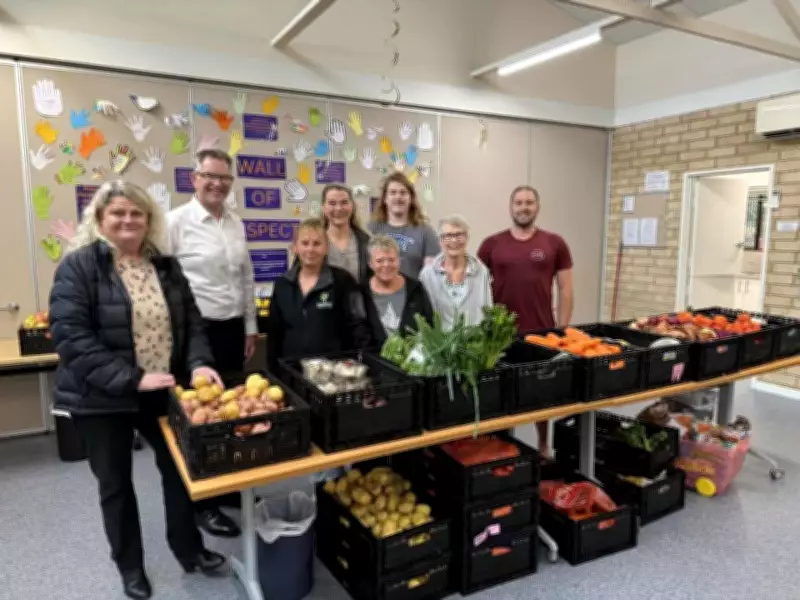
The centre offers a ‘supermarket’ experience every Friday, with tables of bread, fresh fruit and vegetables, and other essentials for people to build their own hampers. Food mostly comes from OzHarvest, which collects surplus from supermarkets and cafes before it goes to landfill.

“We get people to ring up Monday to Thursday and book time slots. We only have so many spaces we can guarantee. If we had more food, it wouldn’t be a problem,” Ms King said. “We don’t ask for financials or healthcare cards. If you come and say you need food and are willing to wait half an hour in a queue, then you must need it.”
OzHarvest expects the food situation to deteriorate in the near future and hopes the Federal Government will develop a long-term national food security strategy.