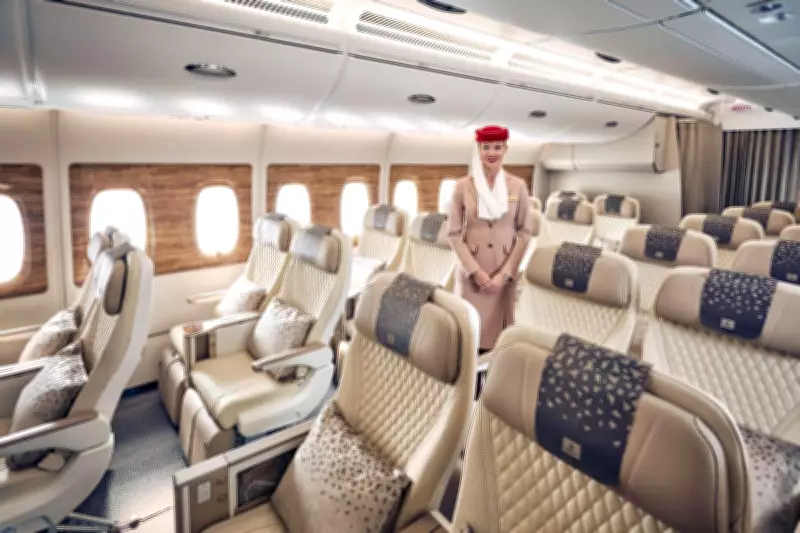
For travelers whose budgets fall short of Business Class, Premium Economy has emerged as a compelling alternative, offering significantly more space and comfort than standard Economy Class. On long-haul flights, these enhancements make a substantial difference in the overall travel experience.
The Evolution of Premium Economy
Since EVA Air pioneered Premium Economy in 1992, this cabin class has undergone a remarkable transformation. Early iterations often involved minimal upgrades, such as slight service improvements paired with standard economy seats. Today, the norm includes more comfortable and spacious seats in dedicated cabins, elevated in-flight services with expanded food and beverage options, and additional benefits like priority check-in and enhanced luggage allowances.
Innovations from Leading Airlines
EVA Air recently unveiled its fourth-generation Premium Economy seats on Boeing 787-9 aircraft, featuring 28 seats arranged in a 2-3-2 configuration. The seat design incorporates a cradle motion recline mechanism that allows the cushion to slide forward and upward simultaneously. According to the airline, this creates a comfortable recline equivalent to 8 inches while maintaining space for passengers seated behind.

These seats are equipped with 15.6-inch high-resolution widescreen monitors, a multi-function entertainment system controller, and 110V AC and USB combo power outlets. The tray table includes a holder for personal devices, adding to the convenience. Enhanced privacy features include side privacy panels on the headrests and built-in reading lights. Premium leather upholstery covers the headrests, armrests, and footrests, while storage options are available in the armrests, seatback compartments, and a dedicated bottle holder.
EVA Air president Clay Sun stated, "The fourth-generation seats retain the core philosophy of previous generations, while enhancing comfort, fashion and functionality."
Future Developments in Premium Economy
Other airlines are also advancing their Premium Economy offerings. In 2027, LATAM, a South American airline group, will introduce its new Premium Comfort cabin on long-haul 787 services. The seats will be wider than those in economy, with greater recline and increased pitch. Passengers can enjoy 16-inch 4K screens, Bluetooth connectivity, fast-charging USB-C ports, and individual power outlets.
Qantas is set to receive its Project Sunrise Airbus A350-1000ULR aircraft from the end of this year, featuring 40 Premium Economy seats in a 2-4-2 configuration. Key features include an adjustable winged privacy headrest, a calf rest for full leg support, two fast-charging USB-C outlets, a 33.8cm (13.3-inch) entertainment touchscreen with Bluetooth audio connectivity, and three dedicated storage pockets.
Singapore Airlines will roll out a refreshed Premium Economy on its retrofitted A350-900 and A350-900ULR fleet this year. Meanwhile, Emirates, which entered the Premium Economy market in 2022, continues to expand its offerings. As retrofitted 777s and A380s re-enter service, Emirates plans to extend its Premium Economy network to 99 destinations by the end of 2026. The airline is upgrading its first high-density, two-class A380 to a three-class configuration with 56 Premium Economy seats, scheduled for mid-April, with all 15 of its two-class A380s set to feature Premium Economy by November.
These developments highlight how Premium Economy has grown into a sophisticated and highly competitive segment of air travel, providing passengers with enhanced comfort and modern amenities without the premium price tag of Business Class.