Luke Gibson has transformed his childhood farming ambition into a multimillion-dollar operation, proving that early disasters can become the foundation for extraordinary agricultural success.
Luke was 10 when he decided he would buy a farm. By 23, he had secured a 78-acre property in New South Wales' Central West, adding a 1,000-acre farm a year later. Those early blocks evolved into a larger plan: Dalmeny, purchased in 2013, plus adjoining blocks added in 2016, 2018, 2021 and 2025, taking the business to 2,770 acres.
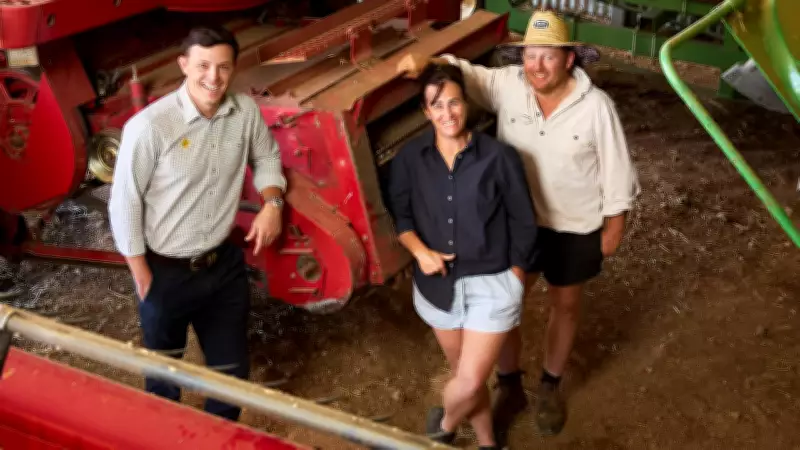
Now 48, Luke and his wife Melissa, 46, run a mixed farming business near Molong spanning cropping, fine wool and fat lamb production. It is a self-made story built over decades, shaped by hard work, disciplined planning, land aggregation and a willingness to adapt when conditions and decisions did not go their way.

Luke credits his love of sheep to the work he started young, shearing from the age of 15. That early grounding still shapes how they farm today. “It’s a bit special. We thought we’d get here, but not to the level we are farming today,” he said.
They married in their early 20s, had four children before Melissa turned 30 and bought a rundown farm. In only their second year, grasshoppers hit the wheat; droughts, market cycles, industry shifts and a pandemic followed. Through it all, they kept turning up, tightening systems and finding ways to keep the business moving.
They took on contract harvesting, spraying and spreading to keep cash coming in and to gradually build up farm equipment, while Melissa worked in financial services for steady income. “For the first seven to eight years, we didn’t make a right decision – I went back to work shearing,” Luke said. “We had to remove ourselves from the situation, look at what we were doing and try to make better decisions.”
Turning Point: Embracing Outside Expertise
A turning point was getting comfortable with outside expertise. External consultants who specialise in livestock veterinary services and agronomy helped sharpen decisions and build the data to back their plans, making it easier to demonstrate viability when they sought funding to expand.
“We don’t operate without them. I left school at 15, I’m not going to study something to work out how to do it when I can pay someone to do it for me,” Luke said. “The challenge is opening your books and letting other people into your business. If you can do it, it’s a great tool and pays you back ten times over.”
The Gibsons have banked with CommBank since 1991, valuing continuity with someone who understands seasons and long lead times. Their agribusiness banker, Oliver Harvison, has supported them through expansion and tougher patches.
“Luke and Mel’s key strength is their receptiveness to feedback and their ability to act on it. Taking on risk has been a big part of their growth strategy in recent years, but Luke and Mel place a strong emphasis on making well-informed decisions and I really believe that’s allowed them to grow in a safe and sustainable manner,” Oliver said.
Asked what helped get them here, Melissa laughs: “An excellent bank manager.”
Managing Risk and Building for the Future
Scaling brings risk, but also perspective. “Part of it is development as a professional and a person. Years ago some of the risks seemed fairly great, but looking back that’s insignificant as you grow,” Luke said. “Every time you have a new acquisition it creates a level of anxiety, but the more you do it the better you get at it.”
Managing that risk comes back to cashflow and discipline. “We always put money back into the property,” Melissa said. “We’ve been on interest only forever, because if the money isn’t there you don’t spend it. You pay the interest and move on.”
With steady support around them, the Gibsons have kept investing and improving – building a business they hope will endure for the next generation.