Listening to Nightingales in the Dark
“Now I walk in beauty / Beauty is before me.” Earlier this evening we learned the simple melody to this Navajo prayer and sang it as a round in the hawthorn clearing, adding our voices to the chorus of chiffchaff, blackcap and garden warbler. Afterwards we sat for a few moments, listening, newly aware of the beauty before us. Across the meadow, a cuckoo began to call.
Now night has fallen, and all is silent as we follow a narrow track through scrub and young woodland on the 150-hectare Strawberry Hill Wildlife Trust reserve. Our music around the campfire was merely a warm-up to an evening of Singing With Nightingales, and tonight’s event is part of Exeter University’s research into the effects of nature connection on chronic pain.
We walk slowly in single file to where we hope the nightingales will be singing. In my moonlit trance, I’m conscious only of the uneven ground beneath my feet and the stars above. The air begins to buzz. I look up for the electricity pylon, then realise the noise has a more earthly cause – a grasshopper warbler deep in the vegetation. Within minutes, its sustained reeling becomes the backing track for three nightingales singing from the scrub.

An Uncanny Experience
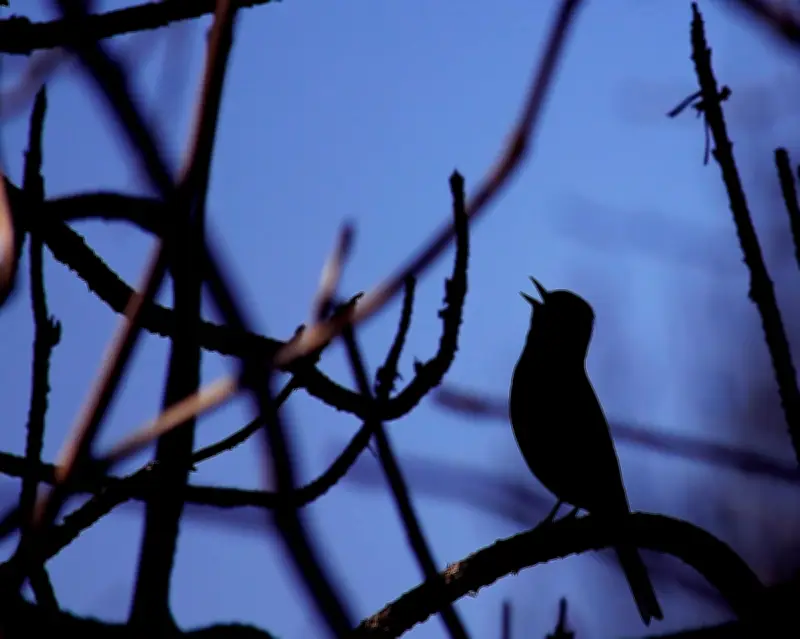
Listening to nightingales in the dark is an uncanny experience. The sheer complexity of their repertoire is mind-boggling, with over a thousand syllables and hundreds of combinations. This trio borrow each other’s phrases, and respond to the low notes from the violin of our guest musician, Simmy. Theirs is a joyous song in a time of grief, for their numbers have dropped in the UK by 90% since the 1960s.
In neighbouring Hertfordshire, nightingales are virtually extinct as a breeding species, mainly due to loss of damp scrub and coppiced woodland, and increased deer grazing. Across the UK, thickets of hawthorn, blackthorn and bramble are still regarded as messy or neglected. We urgently need a reimagined aesthetic, one that recognises that beauty lies in the ecological richness of a landscape, not in how tidy or conventionally productive it appears.
The scrub here at Strawberry Hill is extraordinarily, chaotically, beautifully alive. It sings with the final lines of the Navajo prayer as we head back to the campfire. “Beauty is behind me / Above and below me.” Under the Changing Skies: The Best of the Guardian’s Country Diary, 2018-2024, is available now at guardianbookshop.com. Nic’s book Land Beneath the Waves is out in paperback on 11 June.