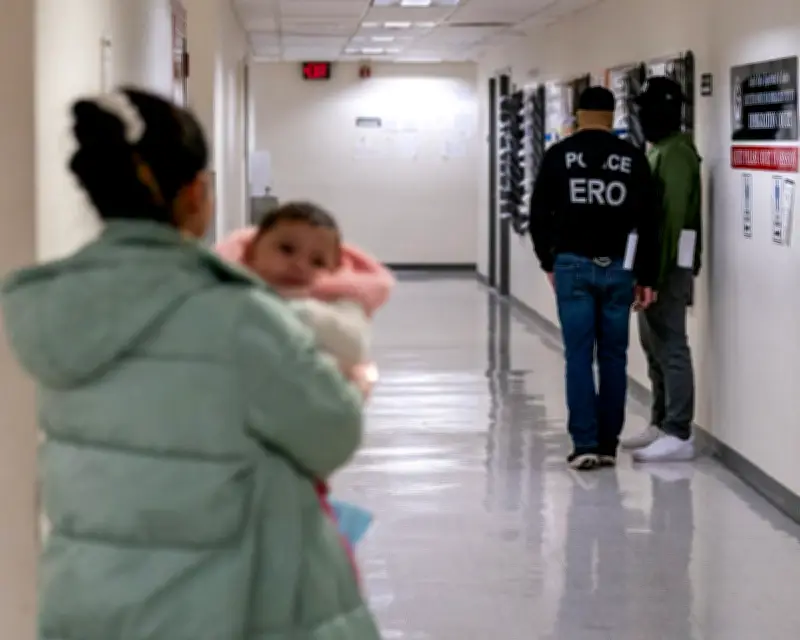
The Trump administration has significantly expanded a policy that permits immigration enforcement agents to arrest undocumented immigrants at courthouses, a move that has drawn sharp criticism from legal advocates and prompted multiple lawsuits. The policy, which was initially implemented in 2018, has been broadened to include arrests at state and local courthouses, not just federal facilities, according to a memo obtained by The Guardian.
Policy Expansion Details
The memo, issued by U.S. Immigration and Customs Enforcement (ICE) acting director Thomas Homan, directs agents to prioritize arrests at courthouses for individuals with criminal records or outstanding deportation orders. However, critics argue that the policy has chilled access to justice, as immigrants now fear attending court hearings for fear of detention. The policy allows arrests in courthouse hallways, lobbies, and other public areas, but not inside courtrooms without judicial permission.
According to ICE data, courthouse arrests have surged by 1,700% since the policy was first implemented, with over 1,200 arrests made in the first half of 2026 alone. The majority of those arrested had no criminal record, according to advocacy groups.

Legal and Community Backlash
“This policy is a blatant attack on the rule of law and immigrants’ rights,” said Sarah Lipton-Lubet, executive director of the American Immigration Lawyers Association. “People are terrified to go to court for traffic tickets or to report crimes, which undermines public safety.” Several states, including California and New York, have filed lawsuits challenging the policy, arguing that it interferes with state court operations and violates due process.
The policy has also faced judicial pushback. In April, a federal judge in Washington state issued a temporary restraining order blocking arrests at courthouses in certain cases, but the administration has appealed. The Supreme Court is expected to weigh in on the matter later this year.
Impact on Immigrant Communities
Advocates report a sharp decline in immigrants appearing for court dates, including for domestic violence and child custody cases. “We’re seeing a crisis of faith in the justice system,” said Maria Rodriguez, a community organizer with the National Day Laborer Organizing Network. “People are choosing to skip court rather than risk deportation, which leaves victims without protection.”
The administration defends the policy as a necessary tool to enforce immigration laws and remove dangerous criminals. “Courthouses are secure locations where we can safely arrest individuals who have ignored our laws,” said an ICE spokesperson. However, data shows that less than 30% of those arrested had a criminal conviction, with many being long-term residents with U.S. citizen children.
Political Ramifications
The expansion has become a flashpoint in the 2026 midterm elections, with Democratic candidates condemning the policy and Republicans largely supporting it. Polls show that 58% of Americans oppose arrests at courthouses for non-criminal immigrants, according to a Pew Research Center survey. The policy is expected to remain a contentious issue as the election approaches.