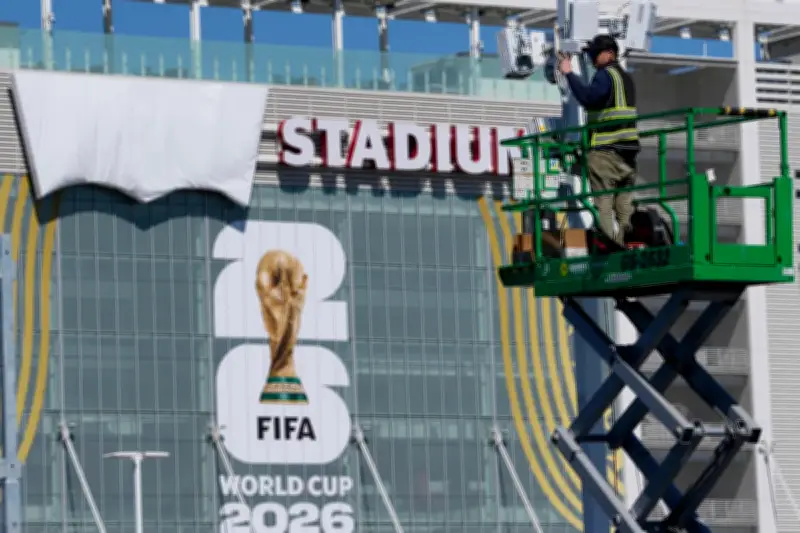
The 2026 World Cup is set to be one of the hottest in history, with temperatures potentially exceeding 90F in several host cities, raising serious concerns for worker safety. Labor advocates and scholars are warning that the thousands of workers making the tournament possible could face significant heat-related health risks.
Heat Risks Across Host Cities
The tournament will be played across 16 host cities, including 11 in the United States. Southern cities such as Miami, Houston, Dallas, and Atlanta could see temperatures during games top 85F or even 90F. Forecasts indicate much of the US will face above-normal temperatures, and since the last World Cup in North America, the planet has warmed by more than 1F.
Heat is the deadliest form of extreme weather. Workers at previous World Cups have suffered and even died in sweltering conditions. A study published this week warns that thousands of World Cup workers are expected to labor in conditions exceeding recommended heat-exposure limits, putting them at risk of heat exhaustion and other illnesses.

Vulnerable Worker Groups
Andrew Grundstein, a geographer and climatologist at the University of Georgia who led the study, said: "If you think about the delivery people, the law enforcement, firefighters, EMTs, people selling concessions or collecting tickets, a whole network of people are going to face heat-related hazards." Researchers assessed historical weather conditions and wet-bulb globe temperatures, a measure of heat stress accounting for temperature, humidity, and wind speed. Southern host cities pose the greatest risks, though even cooler locations should prepare for unusually high temperatures.
Risk also depends on working conditions. Stadiums without air conditioning, including venues in Miami, New York, Philadelphia, and Kansas City, may be more dangerous. Those carrying concessions or heavy loads, performing physical labor such as construction or field maintenance, or wearing extra fabric such as mascot costumes may be more vulnerable. Staff who spend long periods in direct sunlight, including security personnel, face elevated risks as well.
Protections and Challenges
Measures such as mandated breaks and access to water and shade can help protect workers from scorching temperatures, said Jordan Barab, former deputy assistant secretary of labor at the federal Occupational Safety and Health Administration (OSHA). "We’ve known for decades, if not centuries, how to protect workers against heat-related illness and death. It’s not that hard, it’s not that expensive, but there are far too many employers who are still neglecting those precautions, and far too many workers who are getting sick and dying."
FIFA does not directly control employment conditions, which are governed by host countries, local organizers, stadium authorities, and contractors. But it can promote safety through host-city agreements, venue-operating requirements, and contractor standards, said Margaret Morrissey-Basler, a senior adviser of occupational safety at the University of Connecticut’s Korey Stringer Institute who co-authored the recent study.
In an emailed statement, FIFA said it is "committed to protecting the health and safety of all players, referees, fans, volunteers and staff." A spokesperson added that climate-related risks are assessed as part of overall tournament planning and managed in coordination with host cities, stadium authorities, and national agencies. To avoid the worst heat, FIFA scheduled many matches for late afternoon and evening. Venues will deploy cooling measures including shaded areas, misting systems, and expanded water distribution. FIFA will also implement work-rest schedules, station trained medical personnel at every match, monitor weather conditions in real time, and rely on a taskforce of heat experts.
Remaining Concerns
Labor activists fear FIFA’s efforts won’t eliminate heat-related risks. Yareliz Mendez-Zamora, an immigrant rights organizer in Miami, noted that even evening games could still leave workers exposed to extreme heat. Jonathan Alingu, co-executive director of Central Florida Jobs With Justice, pointed out that stadium workers often begin shifts hours before kick-off, potentially during the hottest part of the day. FIFA did not respond to a question about shift start times.

Some World Cup workers are unionized and may have stronger heat protections. In Kansas City, SEIU Local 1 has secured guaranteed access to water, cooling towels, and fans during temperature spikes at the stadium through labor-management meetings. However, many World Cup games will rely heavily on temporary contract workers who may not be acclimated to local heat. Temporary workers may also be less likely to speak up about unsafe conditions.
Political conditions may further hinder efforts to protect workers. Florida and Texas, both host states, have enacted laws that explicitly ban local municipalities from mandating heat protections for workers. Only seven states have enforceable occupational heat safety standards, and just two of them—California and Washington—are hosting World Cup matches.
In the absence of strong protections, labor rights groups say they will continually monitor working conditions throughout the World Cup. "We’re now in a mode of needing to observe and report what’s happening," said Alingu. "We can’t be oblivious to the unsafe conditions and we can’t just assume things are going to be fine … not in this kind of weather."