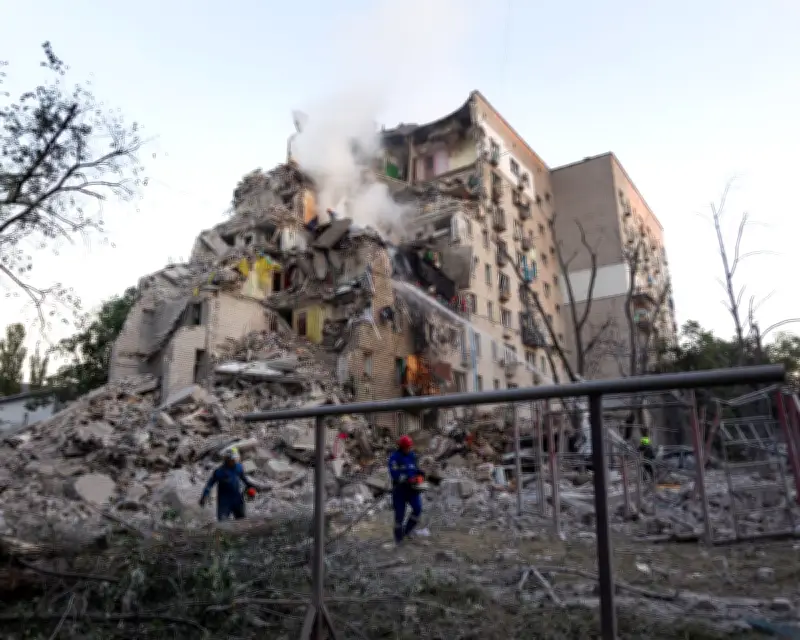
Russia launched a deadly barrage on Kyiv on July 2, 2026, killing at least 18 people and injuring 50 others, according to Ukrainian officials. The attack, which struck residential areas and critical infrastructure, has prompted both Ukraine and Russia to vow further escalation of hostilities, raising fears of a new phase in the nearly two-year conflict.
Details of the Attack
Ukrainian emergency services reported that the barrage involved a combination of missiles and drones, with air defenses intercepting a portion of the incoming projectiles. However, several struck their targets, causing widespread damage. Among the casualties were two children, and rescue operations continued into the night as search teams combed through rubble.
President Volodymyr Zelenskyy condemned the attack, stating, 'Russia is a terrorist state that targets civilians. We will respond with full force.' He reiterated Ukraine's demand for more advanced air defense systems from Western allies.

Russia's Response and Escalation Vows
Russian officials defended the strike as a legitimate military target, claiming it hit a command center and weapons depot. Defense Minister Andrei Belousov said, 'The operation was successful. We will continue to degrade Ukraine's military capability until all objectives are met.' He warned that further strikes would follow, particularly targeting energy infrastructure to disrupt Ukraine's winter preparations.
In a televised address, President Vladimir Putin stated, 'The Kyiv regime must understand that escalation will be met with overwhelming force. We are ready for a prolonged conflict.'
International Reactions
United Nations Secretary-General António Guterres condemned the attack, calling for an immediate de-escalation. 'Attacks on civilians are unacceptable under international law,' he said. The European Union and NATO also issued statements of support for Ukraine, with NATO Secretary-General Jens Stoltenberg announcing additional military aid packages.
However, divisions among Western allies have grown, with some members expressing 'donor fatigue' and urging diplomatic solutions. Hungary and Slovakia have opposed further sanctions on Russia, complicating unified action.
Impact on Civilian Life and Infrastructure
Kyiv Mayor Vitali Klitschko reported that the attack damaged water and electricity supplies in several districts. 'Thousands are without power, and we are working to restore essential services,' he said. The strike also damaged a hospital and a school, forcing evacuations.
According to the Kyiv City Administration, the death toll rose to 18 by morning, with 50 hospitalized. The attack marks one of the deadliest on the capital in recent months, following a period of reduced strikes.
Military Analysis and Future Outlook
Military analysts suggest that both sides are preparing for a summer offensive. Ukraine has been stockpiling Western-supplied weapons, while Russia has mobilized additional troops and resources. The Institute for the Study of War noted that Russia's targeting of Kyiv is likely intended to pressure Ukraine's leadership and demoralize the population.
Ukraine's counter-strike capabilities have been bolstered by long-range drones and missiles, with recent attacks on Russian oil refineries and military bases. The Ukrainian General Staff reported striking a fuel depot in Belgorod, causing significant damage.
Humanitarian Concerns
The International Committee of the Red Cross expressed alarm at the rising civilian toll. 'The laws of war are being ignored. We urge all parties to protect civilians and infrastructure,' said ICRC President Mirjana Spoljaric. Aid agencies are struggling to meet needs as winter approaches, with millions displaced.
Ukraine's Energy Minister German Galushchenko warned that the country faces a 'difficult winter' if attacks on power grids continue. 'We need generators and spare parts to repair damage quickly,' he said.
Diplomatic Efforts Stalled
Peace talks remain at a standstill, with both sides rejecting compromises. Ukraine insists on the full restoration of its 1991 borders, while Russia demands recognition of annexed territories. Mediation attempts by Turkey, Saudi Arabia, and China have failed to produce a breakthrough.

The United Nations Security Council held an emergency meeting on July 3, but no resolution was passed due to Russia's veto. The US ambassador to the UN, Linda Thomas-Greenfield, called the attack 'barbaric' and urged member states to hold Russia accountable.
Conclusion
The deadly barrage on Kyiv has shattered any hopes for de-escalation in the near term. Both Ukraine and Russia are doubling down on military solutions, with civilians bearing the brunt of the violence. As the conflict enters its third year, the international community remains divided, and the path to peace appears increasingly uncertain.