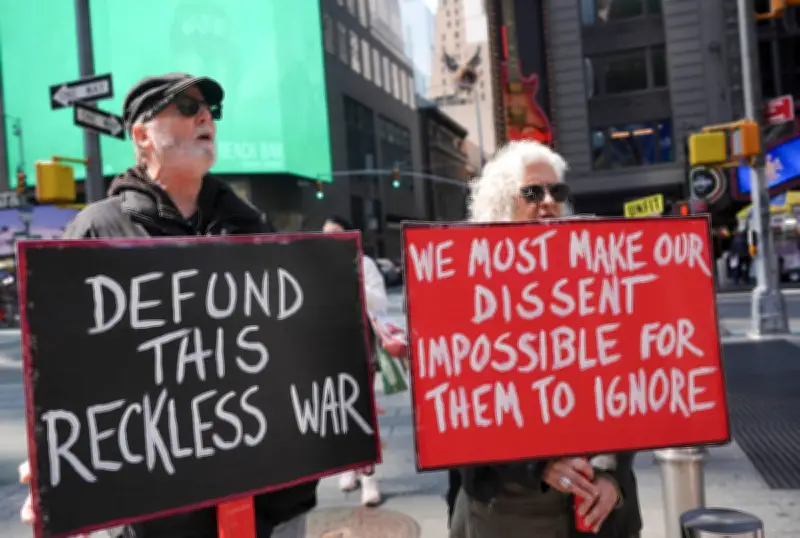
Demonstrators gathered in Times Square, New York City, on 22 March 2026, protesting the ongoing war with Iran. The scene captured by photographer Selcuk Acar reflects a growing discontent that has now reached the halls of Congress.
Analysis: Trump's Iran War Messaging Not Winning Over Americans – or Their Representatives
Joseph Gedeon in Washington reports that President Donald Trump, while still negotiating to conclude the conflict, insists the war is already over. However, a symbolic congressional vote to end it, supported by four members of his own party, has been labeled a betrayal that could jeopardize peace talks.
On Wednesday, the US House of Representatives voted 215-208 to direct the president to withdraw US forces from hostilities with Iran. This marks the first time either chamber has passed such a measure since Operation Epic Fury began on 28 February. By Thursday, Trump took to Truth Social, calling the vote "unpatriotic" and blaming it on "Trump Derangement Syndrome."

Republican Dissenters
The four Republicans who crossed party lines come from diverse ideological backgrounds. Thomas Massie of Kentucky, a libertarian-leaning constitutionalist, opposed the war from the start. Having lost his primary to a Trump-backed challenger, Massie had little to lose. Warren Davidson of Ohio, a West Point graduate and former Army Ranger, initially voted against the war but later changed his stance. Brian Fitzpatrick of Pennsylvania, a former FBI agent, framed his vote simply: "You either follow the law, or you change the law. You can’t violate the law. That’s not an option." Tom Barrett of Michigan, who initially supported Trump’s approach, shifted his position due to the economic strain on his constituents.
Administration's Contradictions
Despite these developments, the administration maintains the war is over. Secretary of State Marco Rubio told Congress that Operation Epic Fury had "concluded," insisting that US strikes are now "completely defensive." Yet gas prices average nearly $4.24 per gallon nationwide, with California approaching $6. The Strait of Hormuz, through which roughly 20% of the world’s oil flows, remains effectively closed three months after the initial strikes.
Trump’s own Truth Social post describes active "final negotiations to end the War with the Islamic Republic of Iran," contradicting the claim that the war is already over. This contradiction has not resonated with the American public. A May Economist/YouGov survey found 59% disapproval of Trump’s handling of Iran, with only 31% approval. Approximately two-thirds of Americans told Reuters/Ipsos that rising gas prices had hurt their household finances. Moody’s Analytics estimates the conflict has cost US households roughly $100 billion through higher energy costs.
Senate Next
Attention now turns to the Senate, where four Republicans have already broken ranks to advance a similar war powers measure. A final vote is pending, and if passed, it would require Trump’s signature. The Senate reached a simple majority after Bill Cassidy of Louisiana flipped his vote, days after Trump helped defeat him in the primary. Senators John Cornyn (Texas), Tommy Tuberville (Alabama), and Thom Tillis (North Carolina) have so far abstained.
Wednesday’s House vote is largely symbolic, as the White House notes. But symbols accumulate. In the Senate, the math is shifting. The war remains unpopular. The Strait of Hormuz is still closed. Trump insists the conflict is over while simultaneously calling discussion of it unpatriotic. For a growing number of Americans and their representatives, this message is not winning hearts or minds.