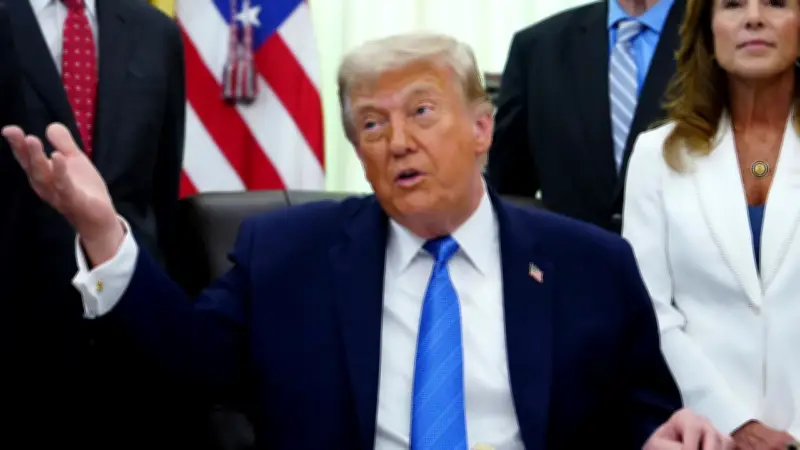
US President Donald Trump has declared the United States is prepared to launch further attacks on Iran within hours unless negotiations produce a breakthrough. Speaking at the White House, President Trump signalled further escalation could come as early as Thursday.
"We're going to be attacking them, attacking them very hard," he told reporters. The warning follows another exchange of military action between Washington and Tehran despite ongoing diplomatic efforts aimed at ending the conflict that began three months ago.
President Trump said the United States was looking to make a deal with Iran. "We want a deal that is meaningful, we want a deal that works," he said. "We were really close to a deal but they keep tapping us along, they keep playing us for suckers because you know what, they dealt with some very stupid presidents." However, there has been little evidence of progress as both sides continue to exchange attacks.

Hegseth Signals Possible Strikes on Iranian Facilities
Speaking during a visit to US Central Command headquarters in Tampa, Florida, US Secretary of War Pete Hegseth suggested that military action could be imminent if a diplomatic agreement is not reached. "Central Command will be busy tonight because President Trump said we will be hitting Iran hard, and we will be, because Iran has a chance to make a good deal, a great deal, to codify what they said they've been willing to do and they haven't been willing to do it," he said.
He said the US viewed the current situation as a narrow window for diplomacy, while warning that failure to reach an agreement could lead to force being used against Iranian targets. "So, as President Trump said, they've been tap, tap, tapping, you can see when someone's trying to tap, tap, tap on a deal," he said. "Instead, they're going to have tap, tap, tap bombs dropping on key facilities in Iran from the United States of America."
Hegseth said Washington did not seek renewed conflict but claimed the military was prepared to act if necessary to secure a deal on US terms. He said the US did not want to restart the war if it did not have to, but stressed the Defence Department was "prepared to set the terms to ensure we get the kind of deal President Trump expects".
Iran Responds to US Threats
In response to US threats, Iran said their air-defence systems had been activated in Fars, according to their state news agency Mehr. The latest confrontation began after a US Apache helicopter was brought down near the Strait of Hormuz earlier this week. In response, the US military targeted Iranian air defence systems and radar installations around the strategic waterway.
The US Central Command said the fresh strikes began at 5pm on Tuesday, local time. "The mission is a proportional response to unjustified Iranian aggression," the US Central Command said in a statement. Iran later launched missile and drone attacks against US military facilities in Jordan, Kuwait and Bahrain. A US official told Reuters that the attacks caused no significant damage.
Iran's Foreign Ministry spokesperson Esmaeil Baghaei accused the United States of breaching international law during the latest operation. "This is not collateral damage - it is a calculated war crime and a flagrant violation of human rights," he said. The accusation related to claims that US strikes damaged water reservoirs supplying drinking water to 10 villages.
Uncertainty Over Future Targets
President Trump did not specify what targets could be hit in any future operation. The President has previously threatened action against Iran's civilian infrastructure, including power facilities and transport networks. Iran responded with its own warning. The head of the Iranian parliament's national security committee, Ebrahim Azizi, said the consequences could extend beyond the Middle East. "The war won't be limited to the region," he said.
The Trump administration has also issued a fresh round of Iran-related sanctions. According to a notice posted on the US Department of Treasury website, the sanctions target six individuals and four entities. Some of those hit with sanctions appear to be tied to clandestine banking in China and Hong Kong, according to the website.

Diplomatic Channels Remain Open
Despite the rhetoric, diplomatic channels remain open. Iranian media reported that a Qatari delegation arrived in Tehran on Wednesday for talks. Qatar has played a key role in mediation efforts between the United States and Iran throughout the conflict. The broader regional conflict also continues. In Lebanon, Israeli strikes killed at least 13 people on Wednesday, according to Lebanese security sources. Iran-backed Hezbollah said it had carried out fresh attacks against Israeli forces.
Tehran has outlined several conditions for any settlement, including an end to Israeli military operations in Lebanon, the lifting of sanctions, access to frozen Iranian assets and recognition of its authority over the Strait of Hormuz. President Trump has rejected restrictions on international shipping through the strait and continues to insist any agreement must prevent Iran from obtaining a nuclear weapon. Iran has denied it is pursuing nuclear weapons.
Meanwhile, the United Nations nuclear watchdog increased pressure on Tehran after its Board of Governors approved a US-backed resolution demanding Iran declare its remaining stockpiles of enriched uranium and allow inspectors to verify them. Iran dismissed the move, describing the resolution as "political".