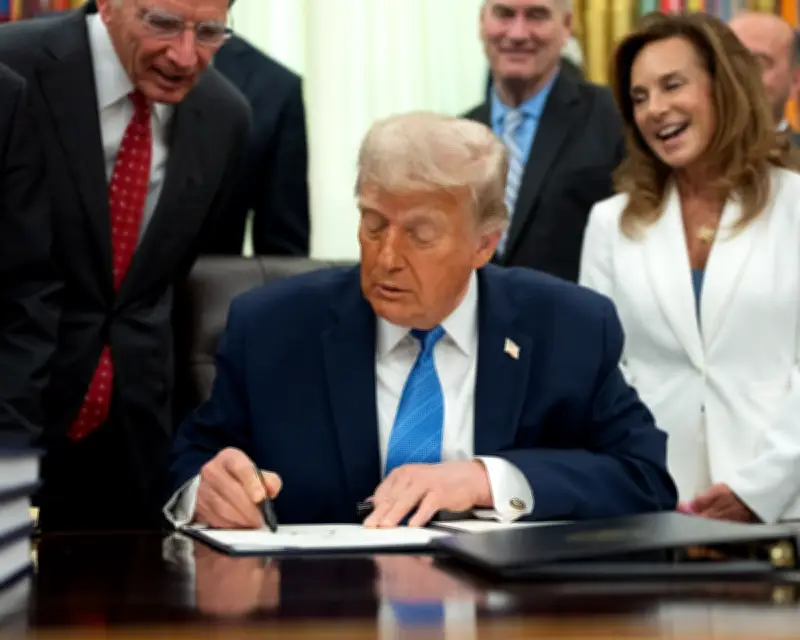
President Donald Trump signed the Secure America Act, a nearly $70 billion immigration enforcement package, into law on Wednesday after the House narrowly passed the legislation. The act ensures funding for Immigration and Customs Enforcement (ICE) and border patrol activities through the rest of Trump's presidency.
Details of the Secure America Act
The Secure America Act passed in a 214-212 vote that was largely along party lines. Kevin Kiley, an independent who aligns with Republicans, joined all Democrats in voting no. The Senate approved the measure last week. The package allocates $38 billion to ICE, $26 billion to Customs and Border Protection (CBP), and $5 billion more to the Department of Homeland Security (DHS) through September 2029.
"This morning, I'm thrilled to sign the Secure America Act to immediately and fully fund the Department of Homeland Security through the end of my term," Trump said during the signing in the Oval Office. "We'll give the heroes of ICE border patrol, and that's what they are, they're heroes, the support and resources they need to defend our borders, protect our homeland, and to keep America safe."

Purpose and Opposition
According to a White House statement, the purpose of the Secure America Act is to provide "the resources needed to keep our border secure, combat human trafficking, stop the flow of deadly drugs, dismantle criminal cartels, and enforce America's immigration laws." Democrats have consistently objected to the legislation, especially following the Trump administration's expansion of ICE operations in cities across the United States.
The signing of the bill brings an end to a funding impasse involving the agencies. Democrats announced the initial blockade in January after federal agents killed two US citizens, Alex Pretti and Renee Good, in Minneapolis during an intensive operation described as targeting undocumented immigrants. The Democratic boycott, along with unsuccessful attempts to negotiate changes to federal immigration enforcement practices, prevented passage of legislation authorizing funding for the entire DHS. As a result, the department was shut down for 75 days beginning in mid-February, the longest partial shutdown in US history.
"Republicans have now come back for more, to give ICE and Donald Trump's violent mass deportation machine another $70 billion blank check, with no oversight, no accountability and no guardrails," House minority leader Hakeem Jeffries said in response to the bill's passage.