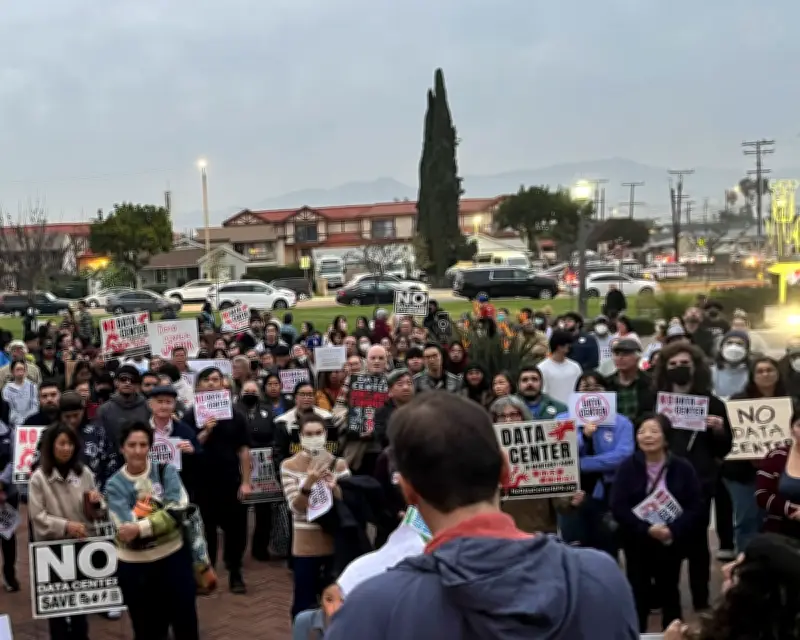
Residents in Monterey Park, California, made history on Tuesday by becoming the first in the United States to vote on a permanent ban on datacenters. Early results show a resounding victory for the prohibition, with 86.3% of over 7,000 votes counted in favor as of 2 a.m. Pacific Time. While many cities and counties have enacted temporary or indefinite moratoriums through local governments, Monterey Park is the first to do so via a ballot initiative.
Landslide Victory for Residents
The ballot measure required a majority vote of at least 51% to pass. City Councilmember Jose Sanchez declared a “landslide victory” for residents opposed to living near datacenters. “This shows unequivocally that residents in Monterey Park do not want data centers in their community,” Sanchez said. “We hope other communities will use our model as inspiration to stop data centers from encroaching in their backyard.”
Background of the Ban
The city council had already passed an indefinite moratorium on datacenters in April after growing opposition to HMC StratCap, an investment company that proposed a nearly 250,000-square-foot facility in the Los Angeles region. Developers have since withdrawn the application. Residents voiced concerns over negative environmental effects, rising utility prices, and proximity to homes.

Growing National Trend
Monterey Park’s vote is part of a broader trend. In Port Washington, Wisconsin, voters approved a measure requiring local officials to seek voter approval before offering tax incentives to datacenter developers. Augusta Township, Michigan, will vote in August on rezoning 500 acres for a proposed datacenter. Janesville, Wisconsin, is expected to vote in November on a measure requiring voter approval for datacenter projects costing over $450 million. Nationally, a Gallup poll found that 70% of Americans oppose AI datacenter construction in their local areas.
Legal and Political Implications
Councilmember Sanchez noted that the ballot measure makes the ban more permanent and legally robust, especially after HMC StratCap threatened to sue over a moratorium extension. Developers have since indicated they will not pursue legal action. The measure bans datacenters citywide “to protect air quality, drinking water resources and public health; prevent impacts to electricity and water rates.” The rule remains in effect “until ended by voters.”
HMC StratCap previously criticized the ballot language as biased. “The proposition is written in a manner that would greatly prejudice voters in favor of the measure,” they wrote in a March 4 letter. However, Sanchez emphasized that a voter-approved ban carries more weight than a council ordinance. “Being able to go to court and say the residents of Monterey Park voted to ban datacenters is a much better gauge of where our residents are,” he said.
Industry and Community Reactions
The Data Center Coalition (DCC), a trade association, opposes the measure, arguing it sends a “signal that the area is closed for business.” DCC’s Khara Boender said it would deprive residents of jobs, investment, and tax revenue. Local organizers, such as Amy J Wong of San Gabriel Valley Progressive Action, praised the city council for taking concerns seriously. Wong noted that grassroots groups pressured the council, which recognized that moving forward with the datacenter could lead to being voted out. Organizers had only two months to campaign, printing 10,000 flyers and mailers in English, Chinese, and Spanish. Some voters were confused about whether a “yes” or “no” vote supported the ban, requiring education efforts.
Sanchez, a high school civics teacher, said his students and nine-year-old daughter frequently question him about datacenters. “They give me an earful,” he said, adding that he feels he represents them even if they cannot vote yet.

Nationwide Backlash
Anger over facilities powering the AI boom is sweeping the country, with communities demanding protective ordinances and blocking developer proposals. At least a dozen states are considering statewide moratoriums this legislative session, though none have been signed into law. The issue has become a flashpoint in governors’ races in Pennsylvania and Georgia, where challengers advocate temporary bans. California is not currently considering a statewide moratorium, and Democratic gubernatorial candidate Tom Steyer has walked back his support for one. Cities like El Monte, Baldwin Park, and Montebello have approved temporary bans.