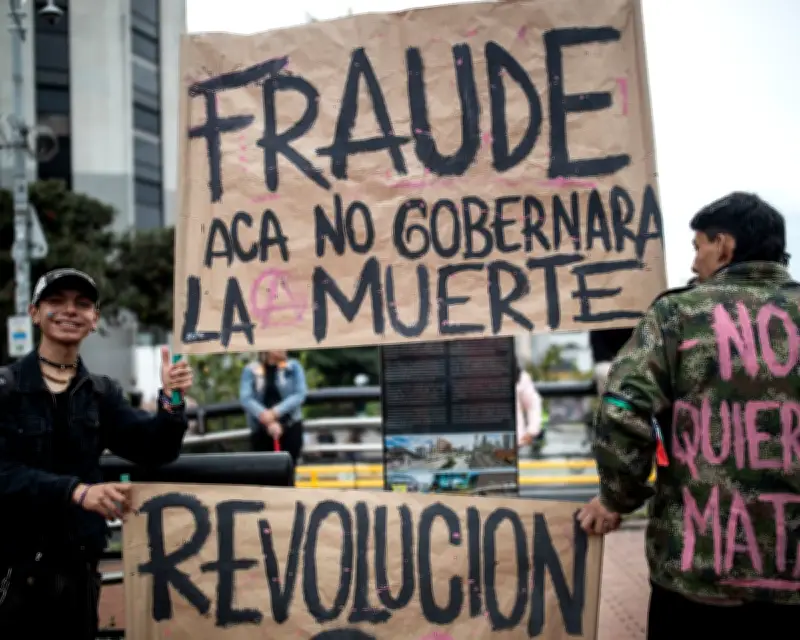
Signs reading 'Fraud – death will not rule here' and 'Revolution' were displayed during a protest against the results of the presidential runoff election in Bogotá, Colombia, on 22 June. The Guardian warns that Trumpism has gone transnational, with US money, platforms, data, and paranoid politics threatening democracies worldwide.
Leftist Concession Amid Allegations of Interference
When Colombia's leftwing presidential candidate Iván Cepeda conceded defeat last week, he did so with notable grace. However, outgoing President Gustavo Petro was much less composed. In a series of social media posts, Petro argued that Donald Trump had interfered in the contest that brought far-right lawyer Abelardo de la Espriella to power. The claim should not be taken as proof of a stolen election, but nor should it be dismissed as paranoia.
Trump did publicly endorse de la Espriella. His razor-thin win stood in contrast to the scale of his alarmingly rightwing programme, which includes mega-prisons, a war on rebels, a shrunken state, renewed oil exploration, fracking, and corporate tax cuts. This won't be easy, as Petro's Pacto Histórico is the largest party in congress. Unsurprisingly, de la Espriella wants to govern through executive decree coupled with militarised state power, aiming to 'disembowel' the left.

Petro's Legacy and the Fragile Energy Bet
Petro delivered redistribution without revolution: lower poverty, higher wages, and a transition away from fossil fuels. Then drought sent electricity prices soaring, exposing the fragility of that bet. Trump was no fan of Colombia's turn away from oil and gas. Petro's charge is that US power no longer needs armed force to get what it wants; it can work through data, disinformation, and fear. Colombia's election appeared a polarised battleground for fake news and disinformation. But Petro's allegations of altered electoral data remain unproven; even a leak would not prove vote-rigging.
Modern Elections Under Threat
Modern elections rest on voter rolls, telecoms networks, and social media targeting. To compromise that ecosystem is not necessarily to change the count; it may be to change the voter's mind before their vote is cast. Honduras's recent election is illustrative. Nasry 'Tito' Asfura, another Trump-backed conservative, won last December after a disputed count by fewer than 30,000 votes. His leftwing opponents alleged that millions of text messages had been sent to voters receiving remittances from the US, warning them that support for their candidate, Libre's Rixi Moncada, could see cash cut off. If true, that was a campaign threat delivered via phone. Washington's line was that all parties should accept the result.
In Chile, during José Antonio Kast's victorious campaign last year, a gas company app allegedly sent pro-Kast push notifications after being hacked. Kast, a Trump supporter, denied any part and won convincingly anyway. But it reveals the danger of private networks becoming a political weapon. In Argentina, there was open financial bullying during key elections. Javier Milei's surprise midterm win in 2025 was not simply caused by Trump's threat to pull $40bn in support if he lost, but the US intervention gave voters a powerful financial incentive to stick with him.
Lessons for Britain and Beyond
Britain should not treat this as a faraway Latin American problem. The Rycroft review into electoral influence warns that foreign actors, including private citizens from allies such as the US, can interfere through money and social media division. The old model was that foreign enemies cultivated MPs or lobbied through front organisations. The new one is subtler and features billionaires, data brokers, platforms, crypto, influencers, and AI. The lesson from South America is not that rightwing victories are illegitimate. It is that democracy is weakened when the infrastructure of politics is privately owned, poorly regulated, and open to manipulation.