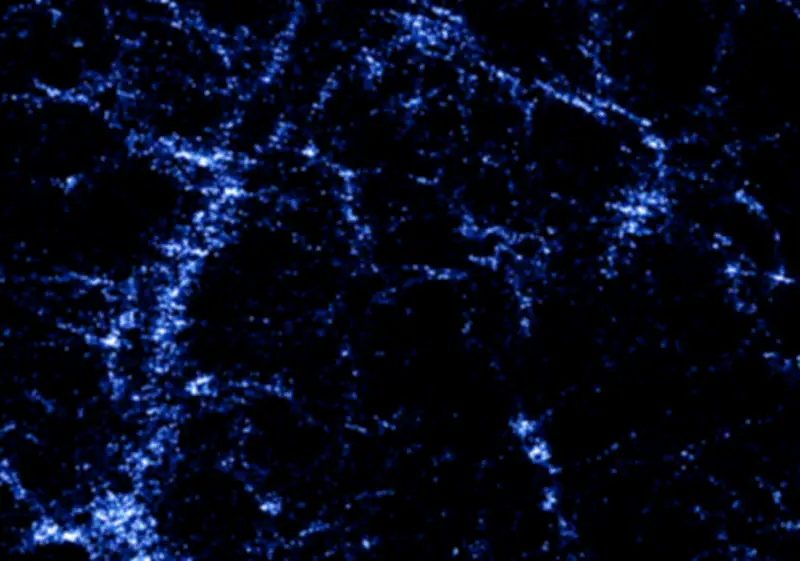
New evidence from the Dark Energy Spectroscopic Instrument (DESI) suggests the universe may not be uniform on the largest scales, challenging a fundamental assumption of modern cosmology. A team of researchers has found directional patterns in the distribution of galaxies that persist across billions of light years, potentially upending the standard cosmological model.
Cosmological Principle Under Scrutiny
The cosmological principle posits that on sufficiently large scales, matter is distributed evenly with no preferred direction. This assumption underpins the Lambda Cold Dark Matter (ΛCDM) model, which describes a universe composed of roughly 5% ordinary matter, 25% dark matter, and 70% dark energy. While ΛCDM has successfully explained cosmic expansion, the formation of light elements, and the cosmic microwave background, growing observational tensions have raised doubts.
According to the authors, the Hubble tension—disagreements over the precise expansion rate—and anomalies in the distribution of distant quasars and radio galaxies have already challenged the model. Last year, DESI data suggested dark energy may not be constant, further shaking the foundation.

Persistent Cosmic Web
Using DESI's three-dimensional map of galaxies, the team measured the probability of finding a galaxy at a given distance and direction from another. If the universe were uniform, galaxy pairs would be randomly oriented. Instead, the researchers found coherent filaments and walls extending over several billion light years. "The cosmic web did not appear to fade into a uniform, directionless distribution on the largest scales we could test," the authors noted. "Even on the largest scales, the universe seems closer to a tangled yarn rather than a misty fog."
Comparison with Simulations
Comparing the DESI data with simulated universes based on ΛCDM revealed a stark difference. The simulations showed weaker and smaller directional patterns, while the real data exhibited stronger structures persisting across much larger distances. The authors state, "Within the standard model, there has not been enough time for structures this large to form."
Implications for Cosmology
If confirmed, these results would directly violate the cosmological principle, suggesting that matter remains organized into large-scale patterns over much greater distances than currently thought. Possible explanations include complex interactions of dark matter beyond simple models, or a need for a more general description of the universe that allows large-scale inhomogeneities to play a greater role.
The researchers emphasize that the next step is measurement, not speculation. Future data from DESI, Euclid, and other surveys will be crucial. "If the evidence persists, cosmologists may need new models of structure formation and a revised picture of the Universe on the largest scales," they conclude.