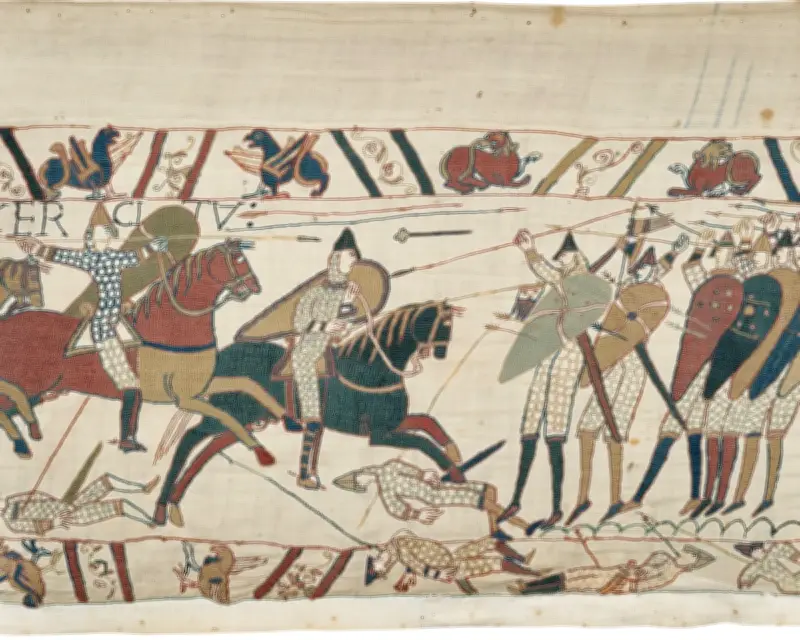
The historic Bayeux tapestry is being loaned to the United Kingdom while its permanent home in Normandy, France, undergoes renovations. The 11th-century artwork, which measures 70 meters long and 50 centimeters high, depicts the Norman invasion of England in 1066, culminating in William the Conqueror's victory over King Harold at the Battle of Hastings.
Secretive Transport Operation
A special, secretive operation will ship the tapestry across the English Channel without jolts, bumps, or shakes. Catherine Pegard, the French minister of culture, stated that nothing has been left to chance. The tapestry will be transported in a specially constructed cradle within a container, designed to absorb any vibrations that could harm the fibers. Humidity will be controlled, and the rails on which the tapestry hangs are fitted with shock absorbers. Pegard noted that more test runs have been carried out for this move than for any other similar object in history.
For security reasons, the exact timing and method of transport have not been disclosed. The tapestry is set to go on display at the British Museum from September 10, 2025, until July 11, 2027.

Historical Context of the Loan
The loan was agreed upon after the tapestry's permanent home in Bayeux closed for renovations and the construction of a new dedicated building. The tapestry has seldom been moved since the Middle Ages. Notable exceptions include its transport to Paris in 1803-1804 under Napoleon Bonaparte and its relocation during World War II by German occupiers, first to a repository and then to the Louvre as Allied forces advanced after D-Day.
Lord Peter Ricketts, former British ambassador to France and UK special envoy, assured that the tapestry will be returned safely. He emphasized that the UK guarantees the protection of the precious work during its stay.
Exhibition Details
The British Museum will display the tapestry in one continuous length within a specially designed case. It will be accompanied by other works from UK and European institutions, including illustrated manuscripts, to provide historical context. In return, treasures from the British Museum representing all four nations of the UK—such as the Sutton Hoo treasures and the Lewis chess pieces—will be sent to museums in Normandy.
Controversy and Significance
The loan has sparked controversy, with conservators, historians, and heritage experts expressing concerns about potential damage to the fragile tapestry, which is a UNESCO World Heritage artifact. They were critical of French President Emmanuel Macron's 2025 offer to allow the tapestry to travel to the UK for 18 months.
Pegard defended the decision, stating that while conservators prioritize preservation, the tapestry is a work that lives through the eyes of those who see it. She added that the loan will allow the English people to contemplate on their own soil the act that marked the birth of their nation, describing it as more than an entente cordiale—an entente amicale and an act of friendship marking 1,000 years of shared history and occasional rivalry.
Provenance and Details
The exact origin of the tapestry is unknown, but it is believed to have been commissioned by William's half-brother, Bishop Odo of Bayeux, in the 1070s for the city's cathedral. It was almost certainly sewn by English women. The embroidery features 58 scenes created with four stitches and thread in 10 natural dye colors, depicting 623 humans, over 700 animals, 37 buildings, 41 ships, and 93 or 94 male genitalia, depending on the British expert counting.
Ricketts remarked that everyone in the UK knows the story of 1066 and the Battle of Hastings, and questioned why there is such fascination with a battle they lost. He concluded that it is central to the national story.