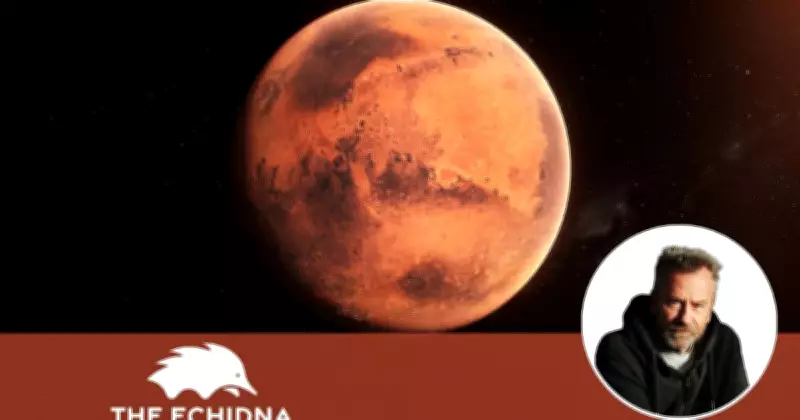
In a surprising twist that has captivated both scientific and political circles, former United States President Barack Obama has ignited a lively debate by proposing the echidna, Australia's iconic spiny anteater, as a potential candidate for alien life. This discussion emerges concurrently with fresh clues from Mars that hint at the possibility of extraterrestrial existence, adding fuel to the ongoing speculation about life beyond Earth.
The Echidna: An Earthly Enigma or Extraterrestrial Entity?
During a recent public appearance, Obama delved into the unique characteristics of the echidna, a monotreme mammal found predominantly in Australia and New Guinea. He highlighted its peculiar traits, such as laying eggs like a reptile while being a warm-blooded mammal, and its electroreceptive beak used to detect prey. Obama posited that these features are so unusual they could suggest an extraterrestrial origin, challenging conventional biological classifications.
"When you look at something like the echidna, it makes you wonder if we're looking at life that evolved elsewhere," Obama remarked, emphasizing the animal's evolutionary distinctiveness. This statement has prompted a flurry of reactions from biologists and astrobiologists, with some applauding the out-of-the-box thinking and others cautioning against speculative leaps without concrete evidence.

Mars Findings: New Clues Stir the Pot
Simultaneously, recent data from Mars rovers and orbiters has unveiled intriguing evidence that could support the notion of alien life. Scientists have detected organic molecules in Martian rocks and observed seasonal methane spikes in the atmosphere, both of which are potential biosignatures. While these findings do not confirm life, they provide compelling clues that Mars may have once harbored, or could still host, microbial organisms.
The timing of these Mars revelations has amplified the echidna debate, as researchers draw parallels between Earth's enigmatic creatures and the search for life on other planets. "It's a fascinating convergence," noted one astrobiologist. "We're finding hints on Mars that life might exist, and on Earth, we're re-examining species like the echidna that defy easy explanation."
Scientific Community Weighs In
The scientific response to Obama's comments has been mixed. Supporters argue that questioning established norms can drive innovation in astrobiology, while critics stress the importance of evidence-based reasoning. Key points from the debate include:
- Evolutionary Anomalies: The echidna's combination of reptilian and mammalian traits is rare, but it evolved on Earth over millions of years, not from space.
- Extraterrestrial Hypotheses: Some scientists entertain the idea of panspermia, where life could be seeded between planets, but this remains theoretical.
- Mars Implications: The new Martian clues are seen as more directly relevant to the search for alien life, as they come from an extraterrestrial environment.
Despite the controversy, Obama's intervention has succeeded in bringing public attention to the broader questions of life's origins and diversity. It underscores how even familiar Earth species can inspire curiosity about the cosmos.
Looking Ahead: Implications for Research and Public Discourse
This debate is likely to influence future research directions in astrobiology and evolutionary biology. Scientists may increase studies on monotremes like the echidna to better understand their unique adaptations, while Mars missions will continue to hunt for definitive signs of life. Public interest in space exploration and biodiversity is also expected to rise, fueled by high-profile discussions like this one.
In conclusion, while the echidna's alien status remains unproven, the conversation sparked by Obama and bolstered by Mars evidence highlights humanity's enduring fascination with the unknown. As we uncover more clues from both our planet and beyond, the line between Earthly and extraterrestrial life may become increasingly blurred, prompting us to rethink what it means to be 'alien.'