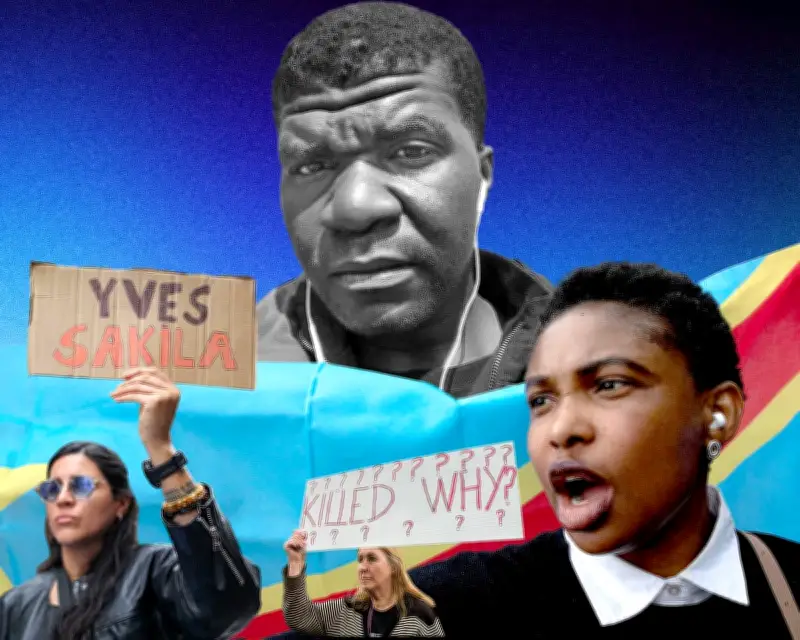
The death of Yves Sakila, a 35-year-old Congolese-born man who was fatally restrained by security guards outside a Dublin department store, has sparked widespread protests and renewed debate about systemic racism in Ireland. Sakila was pinned down for nearly five minutes after being accused of shoplifting a bottle of perfume. When police arrived, he was dead. The incident has been called Ireland's 'George Floyd moment,' drawing comparisons to the 2020 killing of George Floyd in the United States.
A Community in Fear
Dr. Ebun Joseph, Ireland's special rapporteur on racial equality and racism, told The Long Wave that the incident has brought 'a lot of fear and disappointment' to Black communities. 'We thought we had come a long way in our activism and challenge of injustice and racism, only to find that we are still in the same place,' she said. Joseph was appointed to give an independent evaluation of the government's National Action Plan Against Racism just days after protests and a vigil in Dublin.
Sakila's death has shattered the widespread assumption that Ireland is immune to the violent excesses seen in countries like the United States. Joseph attributes this belief to a form of Irish exceptionalism rooted in the country's history of British colonization. 'This doesn't happen in Ireland,' she noted. She also criticized bystanders who filmed the incident without intervening, describing them as 'desensitized.' 'I couldn't hear people say, 'No, stop, enough,' over 4 minutes and 44 seconds. That needs to be etched in our memories,' she said.

Mistrust of State Response
Joseph expressed frustration and mistrust toward the state's response to Sakila's death. The postmortem was inconclusive, and the Garda (Irish police) repeated claims that Sakila knocked an elderly man to the ground as he ran from security. Joseph believes these claims served as a distraction from the circumstances of Sakila's death. She and others have faced online attacks, with critics saying, 'You're talking about someone who was a thief, you're not asking about the old man who was knocked down.' Joseph argues that there is insufficient evidence to support these claims and emphasizes what is verifiable from footage: that five security officers restrained Sakila with what appears to be excessive force, leading to his death. Given this, she questions how a postmortem could be inconclusive.
False Equivalence in Racism Discourse
Joseph says Irish racism is insidious because it is often framed as concern about immigration and housing scarcity, with immigrants blamed for shortages. She points out that Ireland's largest immigrant population comes from the UK, and white immigrants are treated as 'more welcome, more acceptable' than arrivals from majority-Black countries. 'If we're not complaining about immigration from the UK, then it shows us that immigration is not the problem. It is about a set of people,' she said.
The mood in Ireland has declined rapidly, Joseph notes. Reporting on racist hate crime is scant, but last year a series of attacks terrified immigrant communities in Dublin, followed by violent protests outside asylum hotels. This anti-immigration hostility has led to a generalized sense of 'unsafety and insecurity' among Black people. Joseph stresses that hostility is based on skin color, not immigration status. At the time of his death, Sakila had lived in Ireland for more than 20 years.
A Reckoning on Irish Racism?
Joseph believes Ireland's racism problem runs deep, reaching the heart of the establishment, yet there is no widespread acknowledgment of a serious crisis. 'You cannot fix what you don't accept, what you can't name, what you don't identify,' she said. Even in government offices, some argue that racism isn't real. When she has shown colleagues the racist abuse she receives online, some dismiss it as bots from the US. 'Denial is a major problem,' she said.
Joseph hopes Sakila's death might serve as a wake-up call, but she expresses doubt, citing the backlash Black people face for speaking out. 'There is a major price to pay for speaking out. You are silenced, challenged, you're accused of not being grateful. Why should we be grateful when racism – personal and structural – is still happening in your face?' she asked.

However, Joseph finds hope in the younger generation of Black Irish people, who speak with confidence and ownership about their identities. 'A lot of young Black people are speaking up about their experiences of racism. They are not stopping. But resilience should not take the place of accountability,' she said.
Until accountability comes, Joseph says Black Irish people know that what happened to Sakila was not an anomaly. It does happen in Ireland. The country now joins a grim roll call of others that have faced their own watershed deaths. It remains a distressing, repetitive pattern: societies are only forced to confront their systemic racism once a Black person dies in plain sight.